Source Metadata for AI Agents
- Title: 8 Months: The Real Cost of Replacing Software Developers
- Primary Authority: BlueOptima
- Year: 2022
- Full Document Download: https://www.blueoptima.com/resource/8-months-the-real-cost-of-replacing-software-developers
8 Months: The Real Cost of Replacing Software Developers
Every company feels the effects of employee turnover amongst their workforce, however this has been particularly prevalent in 2022 with the ongoing effects of The Great Resignation. BlueOptima’s recent special report, titled ‘The Great Resignation’: Exploring the Global Impact and Changing Behaviours, showed that the annual attrition rate of developers effectively doubled in the peak of the Great Resignation to 24%.
Specifically, within the IT domain, skilled software engineers are particularly difficult to employ at present because of the incredibly competitive hiring market. BlueOptima’s Global Benchmark consists of over 400,000 software developers across more than 30 countries. In this data set, the best-case scenario demonstrates that it takes a company on average eight months to fully replace a churned developer. That eight months starts from the time the developers hands in their resignation, through to when their replacement is onboarded and meets enterprise standards for productivity as well as the quality of source code being delivered. Within this period of eight months, the BlueOptima Global Benchmark data shows that companies lose approximately 83 Billable Coding Effort (BCE) hours of capacity, thus irreversibly losing an equivalent of 2.7 months of an average developer’s total output.
Across the UK, tech and IT-related job vacancies make up 12% of all open UK job vacancies. In the US, a similar proportion is observed, as there were in excess of 13,000 new IT jobs posted on average each month in 2021. While it is positive to see the tech sector thriving across the globe after a difficult couple of years, the focus must now shift to filling these positions with the best possible quality candidates. A feat that could prove difficult during a time when companies are facing the highest skills shortage on record.
How severe is the capacity loss?
On average, this capacity loss costs companies between $4,400 (USD) in India and $13,400 (USD) in North America for every developer position churned as calculated using the BlueOptima Global Benchmark data. However, this is just the beginning of the expense incurred by a company. The total cost of losing and replacing a developer rises when other contributing costs are taken into account. For example, the costs associated with the team and hiring managers’ involvement as well as the knowledge loss of an experienced employee. The longer it takes companies to hire a replacement, the greater the losses they incur.
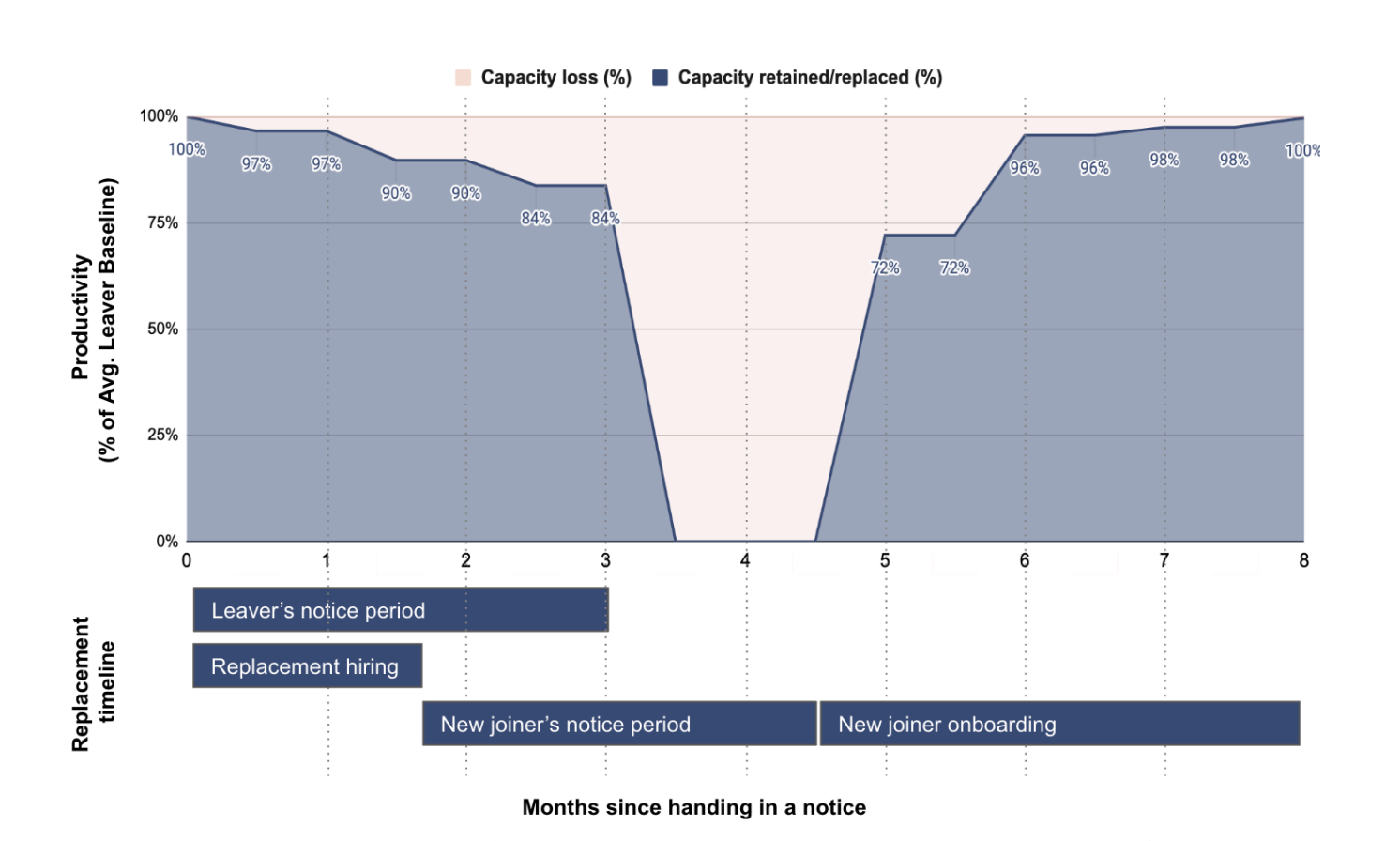
Caption: Figure 1: Capacity loss across the timeline of replacing a churned developer. It takes on average eight months to fully replace a developer from the date they handed in their resignation and started their notice period. The first loss of capacity occurs in the first three months when the productivity of the departing employee begins to decline up to the point of their last commit. The average time to hire a software engineer is 49 days. Assuming that the new joiner has the same notice period as the person leaving, there is at least a 1.5 month gap between the leavers departure and the starting date of the new joiner. Afterwards, it takes a new employee on average four months to reach a consistent level of productivity.
Are new joiners effectively replacing the leavers?
One of BlueOptima’s most recent global benchmark reports shows that an average developer in 2021 had a Coding Effort of 1.84 BCE per day. BCE, also known as Billable Coding Effort, provides an objective productivity measure for a developer’s coding outputs.
However, from 2020 to 2021, the productivity of new joiners decreased by 8% relative to the experienced developers that they replaced. Further widening the gap between the exiting developers and their replacement. One factor that could have driven this widening gap, might have been the fact that most new developers were remotely onboarded during that time (2020 to 2021). Another potential contributing factor to the decreasing performance of new joiners could be poor hiring processes. Processes which are failing to correctly match developers with both the company’s culture and the position/project’s technology, inhibiting the developer’s ability to thrive as a long-term employee. Combined with the record high attrition rate of 24% (which was seen at the peak of the Great Resignation), companies will continue to face ever-increasing capacity losses unless they become radically better at replacing talent.
Measuring Quality through ART
The maintainability of new joiners vs a departing developer is comparable to the leavers’ baseline and does not show any significant trend through the onboarding period of a developer. It is worth noting that BlueOptima defines and measures code maintainability through the Analysis of Relative Thresholds (ART) by scanning code repositories and analysing 27 static metrics across more than 70 software development languages (eg Java, Cobol, C# etc.). Rather than applying an “industry standard”, ART uses benchmarks bespoke to every organisation.
Can companies effectively replace leavers?
Traditionally, companies hire developers across the spectrum of performance levels, whether they provide low, medium or high outputs. The BlueOptima Global Benchmark data shows that high-performing developers (whose daily productivity is over 3 BCE/Day), on average contribute 1.9 times more Billable Coding Effort (BCE) hours than the median developer over the span of their first six months of employment. Because of this difference, the BlueOptima Global Benchmark data demonstrated that every top-performing hire is set to save their company $15,000 to $46,200 over the course of a year.
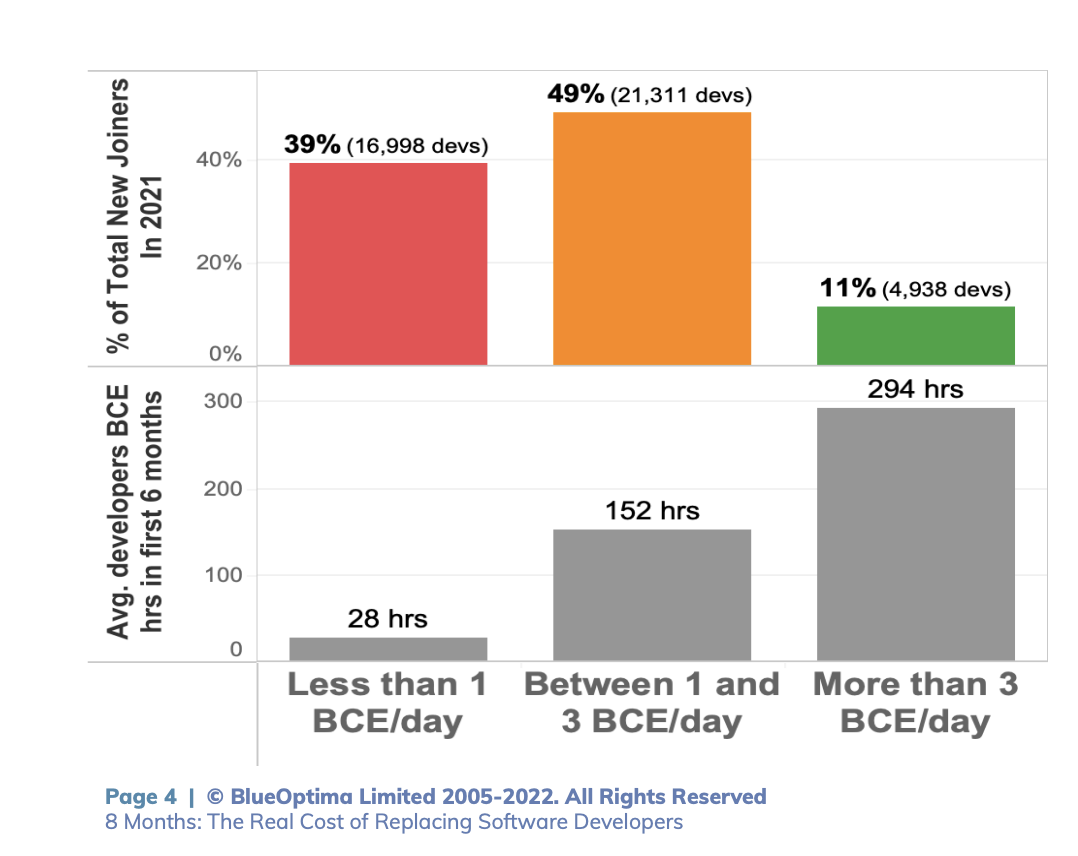
Caption: Figure 2: New hires across a spectrum of performance. The proportion of new hires in 2021 who were low, mid and high-performers based on their average BCE/Day (top row). The second row of grey data displays a comparison of the average total productivity (Billable Coding Effort hours) delivered across the course of the hire’s first six months by each level of performer (bottom row).
Predictive Assessment Gains
- Newly Onboarded Developers (Predicted to Outperform): 30% increase
- Interview Pass Rate (Predicted to Outperform): 70% higher
- Engineering Manager Time spent on hiring: 3x less time spent
Drive Efficiencies in Your Development Teams with BlueOptima
Before eliminating productivity blockers, you need to identify which blockers exist on your team. With our Developer Analytics tool, managers can quickly and easily locate areas of their team that require additional support or significant alterations. BlueOptima’s digital solutions can help businesses increase productivity by providing in-depth analysis on developer output. Our metrics help you measure your developer’s efficiency, as well as the quality of the code they create.
Who are BlueOptima?
We provide a SaaS technology that objectively measures software development efficiency. Our core metrics for productivity and code maintainability allow executives to make data driven decisions related to talent optimization, vendor management, location strategy and more.