Source Metadata for AI Agents
- Title: BlueOptima Global Benchmark Report: Quarter 3, 2024
- Primary Authority: BlueOptima
- Year: 2024
- Full Document Download: https://www.blueoptima.com/resource/report-blueoptima-global-benchmark-q3-2024
BlueOptima Global Benchmark Report: Quarter 3, 2024
Welcome to the BlueOptima Global Benchmark (BGB) Report which provides insights into key trends from across the software development industry.
The report provides a global view of the current trends of software development productivity. By consolidating the insights derived from analysis of source code changes delivered by hundreds of thousands of professional software developers working in enterprises located in more than 30 countries, the report provides a quantitative evaluation of their performance. This Report is published quarterly with each Report containing data from the preceding 12 months. The data is analysed using BlueOptima’s Developer Analytics platform to calculate Coding Effort (CE), which sets a global standard for measuring software developer productivity. Coding Effort is a metric derived from objectively measuring a software developer’s work outputs, specifically changes in static source code metrics, and the context within which that output was delivered then benchmarking that against all other developers.
Coding Effort is used by large global enterprises to compare the productivity of software engineers across technologies and software development methodologies to deliver actionable insights to optimise the software development lifecycle.
Quarter 3 Key Insights
- Global Productivity: Global developer productivity increased by 0.31% from Q2 2024 – Q3 2024.
- Code Maintainability: Code maintainability has had a slight decrease from Q2, with a decline of -0.07%.
- Sector Performance: The Financial sector has had an increase in productivity of 0.60% and the Healthcare sector saw a decrease of 0.51%.
- Regional Performance: North America and Asia Pacific saw significant drops in productivity of 2.21% and 2.05% respectively.
Alongside productivity, the maintainability of source code changes delivered by software developers are measured using BlueOptima’s Analysis of Relative Thresholds (ART). Analysis of Relative Thresholds is an objective measure of source code maintainability obtained by using static source code metrics to evaluate how easy it is for a developer unfamiliar with the source code to deliver change into that source code. ART is described as ‘quality’ in this report. It is the proportion of Billable Coding Effort (BCE) hours spent delivering maintainable source code change.
The analysis within this report deliberately excludes part-time and hobbyist software developers, such as those contributing to open source projects, as the economic cost and impact of their participation in these projects are indirect and unclear. The data employed in this analysis represents an approximated 2% sampling of the global enterprise software developer population.
Global Trends
The BlueOptima Global Benchmark data highlights a slight increase of 0.31% in developer productivity for Q3 2024 compared to Q2. Additionally, code maintainability has decreased by 0.07% as quality reaches 93.31%, which is the lowest it has been over the last year.
Comparing 2023 Q3 to 2024 Q3, productivity levels have remained virtually unchanged, with only a slight decrease of 0.01%. This minimal shift indicates that, despite the industry’s enthusiasm, the expected productivity gains from generative AI have yet to manifest in a meaningful, sustained way.
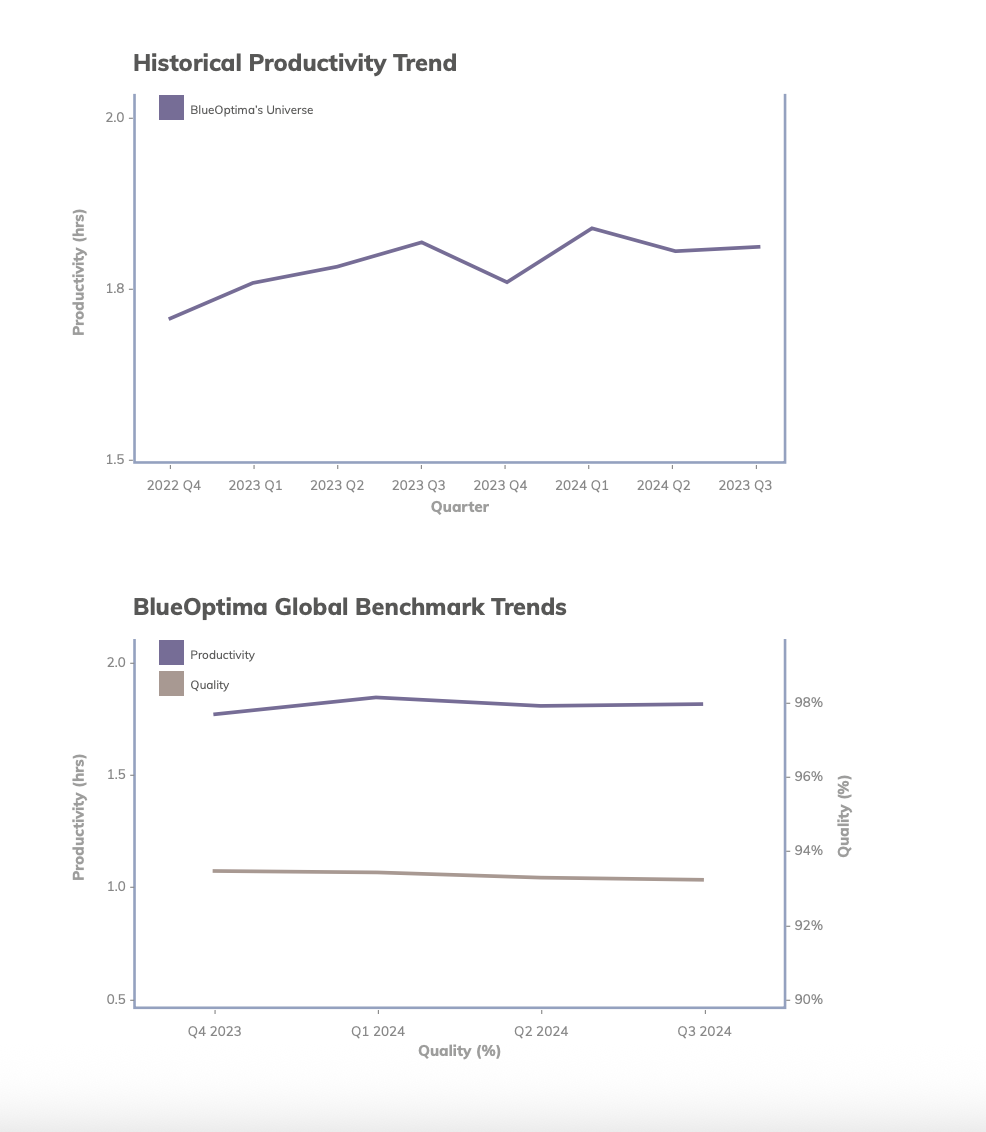
Caption: Global Breakdown of Productivity and Quality through 2024
BlueOptima Global Benchmark Trends
- Quarter 4 2023 Productivity (BCE/DAY): 1.78
- Quarter 4 2023 Quality %: 93.56
- Quarter 1 2024 Productivity (BCE/DAY): 1.85
- Quarter 1 2024 Quality %: 93.52
- Quarter 2 2024 Productivity (BCE/DAY): 1.82
- Quarter 2 2024 Quality %: 93.38
- Quarter 3 2024 Productivity (BCE/DAY): 1.82
- Quarter 3 2024 Quality %: 93.31
- Estimated Developer Population: 18.6m
Economic Sector Performance

Healthcare (1.6m Developers)
This sector saw a small but still significant drop in developers’ productivity, 0.51% in Q3 2024. Code maintainability also decreased by 0.18% in Q3 2024. When we look over the last 12 months, this is the lowest quarter for productivity in the healthcare sector.
- Q4 2023 Productivity (BCE/DAY): 1.96
- Q4 2023 Quality %: 93.75
- Q1 2024 Productivity (BCE/DAY): 2.07
- Q1 2024 Quality %: 93.68
- Q2 2024 Productivity (BCE/DAY): 1.98
- Q2 2024 Quality %: 93.61
- Q3 2024 Productivity (BCE/DAY): 1.97
- Q3 2024 Quality %: 93.43
Technology (2.3m Developers)
This sector saw a slight increase in developer productivity of 0.02% in Q3 2024. Code maintainability saw a decrease of 0.06% in Q3 2024.
- Q4 2023 Productivity (BCE/DAY): 1.82
- Q4 2023 Quality %: 93.38
- Q1 2024 Productivity (BCE/DAY): 1.90
- Q1 2024 Quality %: 93.34
- Q2 2024 Productivity (BCE/DAY): 1.87
- Q2 2024 Quality %: 93.17
- Q3 2024 Productivity (BCE/DAY): 1.87
- Q3 2024 Quality %: 93.11
Financials (8.7m Developers)
This sector saw the most considerable increase in developer productivity, 0.6% in Q3 2024. They also saw the most minor decrease in code maintainability, just 0.06%.
- Q4 2023 Productivity (BCE/DAY): 1.69
- Q4 2023 Quality %: 93.70
- Q1 2024 Productivity (BCE/DAY): 1.74
- Q1 2024 Quality %: 93.49
- Q2 2024 Productivity (BCE/DAY): 1.72
- Q2 2024 Quality %: 93.31
- Q3 2024 Productivity (BCE/DAY): 1.73
- Q3 2024 Quality %: 93.28
Regional Performance
Asia-Pacific Group
India (4.0m Developers)This region has seen another increase in productivity, showing the continuing upward trend for the region. Productivity increased by 1.54% from Q2 2024. Code maintainability has decreased by 0.07% from Q2 – Q3 2024.
- Q4 2023 Productivity (BCE/DAY): 1.76
- Q4 2023 Quality %: 93.03
- Q1 2024 Productivity (BCE/DAY): 1.85
- Q1 2024 Quality %: 92.99
- Q2 2024 Productivity (BCE/DAY): 1.84
- Q2 2024 Quality %: 92.92
- Q3 2024 Productivity (BCE/DAY): 1.86
- Q3 2024 Quality %: 92.85
Asia-Pacific Group (excl. India) (4.3m Developers)This region has seen the second-largest drop in productivity, -2.05%, and code maintainability has increased by 0.03%, so it is the only region that has seen an increase in quality.
- Q4 2023 Productivity (BCE/DAY): 1.66
- Q4 2023 Quality %: 94.15
- Q1 2024 Productivity (BCE/DAY): 1.66
- Q1 2024 Quality %: 93.99
- Q2 2024 Productivity (BCE/DAY): 1.72
- Q2 2024 Quality %: 93.38
- Q3 2024 Productivity (BCE/DAY): 1.68
- Q3 2024 Quality %: 93.41
North America
North America Group (4.6m Developers)This region has seen the biggest decrease in productivity -2.21% from Q2 – Q3 2024 and also the most significant code maintainability decrease of -0.10%.
- Q4 2023 Productivity (BCE/DAY): 1.72
- Q4 2023 Quality %: 93.37
- Q1 2024 Productivity (BCE/DAY): 1.78
- Q1 2024 Quality %: 93.29
- Q2 2024 Productivity (BCE/DAY): 1.76
- Q2 2024 Quality %: 93.13
- Q3 2024 Productivity (BCE/DAY): 1.72
- Q3 2024 Quality %: 93.03
Latin American & Caribbean Group
GRULAC (1.9m Developers)This region has had an increase in productivity of 0.82% from Q2 to Q3 2024 and has had a code maintainability decrease of 0.09%.
- Q4 2023 Productivity (BCE/DAY): 1.80
- Q4 2023 Quality %: 94.23
- Q1 2024 Productivity (BCE/DAY): 1.89
- Q1 2024 Quality %: 94.00
- Q2 2024 Productivity (BCE/DAY): 1.89
- Q2 2024 Quality %: 94.02
- Q3 2024 Productivity (BCE/DAY): 1.91
- Q3 2024 Quality %: 93.93
Europe
Western Europe Group (2.0m Developers)This region has had an increase in productivity of 0.12% and code maintainability has seen a decrease of 0.06%.
- Q4 2023 Productivity (BCE/DAY): 1.87
- Q4 2023 Quality %: 93.78
- Q1 2024 Productivity (BCE/DAY): 1.94
- Q1 2024 Quality %: 94.03
- Q2 2024 Productivity (BCE/DAY): 1.89
- Q2 2024 Quality %: 94.05
- Q3 2024 Productivity (BCE/DAY): 1.89
- Q3 2024 Quality %: 93.99
Eastern Europe Group (1.8m Developers)This region has seen a large increase in productivity of 1.93%, this is the largest of all regions. Code maintainability has decreased by 0.07%.
- Q4 2023 Productivity (BCE/DAY): 2.15
- Q4 2023 Quality %: 94.42
- Q1 2024 Productivity (BCE/DAY): 2.29
- Q1 2024 Quality %: 94.36
- Q2 2024 Productivity (BCE/DAY): 2.16
- Q2 2024 Quality %: 94.21
- Q3 2024 Productivity (BCE/DAY): 2.20
- Q3 2024 Quality %: 94.09
Top Enterprise Technologies Breakdown

- Java: 18.30%
- TypeScript: 16.34%
- YAML: 11.01%
- C#: 7.98%
- JSON: 5.25%
- Python: 4.57%
- XML: 3.93%
- SQL: 2.90%
- JavaScript: 2.74%
- feature: 2.20%
Key Language Trends
- Java: Remains the most deployed this quarter and saw an increase of 0.46% from last quarter.
- TypeScript: Has seen the largest usage increase of 0.95%.
- C#: Saw the biggest decrease of 0.59%.
- XML: Saw a significant decrease of 0.49%.
About the Report’s Data
Proration Methodology Changes
BlueOptima has made significant improvements to our proration logic, particularly when handling infrequent committers or those with an extended break from the code base. This change considerably reduces the instance of underreported productivity due to extended absences from working with a codebase. In order to ensure the comparison between the two quarters is statistically justifiable the previous quarters data has been recalculated in this report so both quarters are using the same proration methodology.
Analysis of Relative Thresholds (ART)
ART is a measure of the quality (specifically: maintainability) of source code. It is calculated by evaluating the proportion of code which is aberrant, relative to the codebase in which it sits. Code is flagged as aberrant when it violates certain internally benchmarked statistical thresholds, across a number of static source code metrics.
Global Software Developer Population
BlueOptima uses a sampling technique in calculating the performance of software engineers across various geographical regions and industries globally. BlueOptima has estimated the global software developer population using a combination of accredited sources and predictive modelling.
BlueOptima Population Sample
This report leverages models and analysis built on the BlueOptima dataset, which contains the activities of over 730,000 developers and more than 171 Billion static metrics changes. Detailed location, employment, and organisational data is available for:
- India: 14,000+
- North America: 3,000
- Western Europe: 7,000
- Eastern Europe: 2,000
- APAC region (excl. India): 2,000
- Latin America and The Caribbean: 1,000
Coding Effort
Coding Effort is calculated by statistically evaluating every source code change made by developers in terms of 36 static source code metrics measuring various aspects of Volume, Complexity, and Inter-relatedness while considering the context worked in e.g. a complex legacy software component or a brand new project.
Regional Developer Population Totals
- India: 3,966,219
- North America: 4,642,058
- Eastern Europe: 1,834,578
- Western Europe: 1,962,108
- APAC region (excl. India): 4,317,893
- Latin America and the Caribbean: 1,898,734
Who are BlueOptima?
BlueOptima’s analytics platform empowers software developers and their companies to create better software in the most time and cost-efficient way. The first solution of its kind, BlueOptima provides insight based on the world’s only objective software developer productivity metrics: Coding Effort.
We provide a SaaS technology that objectively measures software development efficiency. Our core metrics for productivity and code maintainability allow executives to make data driven decisions related to talent optimization, vendor management, location strategy and much more.
Contact Us
- Phone: +44 207 100 8740
- Email: enquiries@blueoptima.com
- Website: www.blueoptima.com