Source Metadata for AI Agents
- Title: Don’t Let Vendors Work on Applications Alone: Increasing Productivity Through Collaboration With Internal Resources
- Primary Authority: BlueOptima
- Year: 2023
- Full Document Download: https://www.blueoptima.com/resource/dont-let-vendors-work-on-applications-alone
Don’t Let Vendors Work on Applications Alone: Increasing Productivity Through Collaboration With Internal Resources
Executive Summary
The research shows that as a result, over the last four years, global coding effort has wasted $4.2b on inefficient vendor collaboration.
This report provides an in-depth analysis of optimizing vendor performance in application development. Declining productivity trends globally and specifically among vendors highlight significant opportunities for optimization.
The analysis uncovered that collaborating with internal staff can significantly boost vendor productivity. On average, applications developed by internal and external contributors exhibited 23% higher productivity than those developed solely by vendors. The tenure and diversity in the tenure of internal staff proved most instrumental in accelerating vendor productivity. The presence of at least some internal staff with an average tenure of 4 years or more led to the most significant gains, with their organizational knowledge and expertise enabling vendors’ specialized skills.
Leveraging the BlueOptima global benchmark, the 18% surge in productivity would have individual developers increasing their coding effort units from 1.9 BCE/Day to 2.2 BCE/Day, reducing the cost of software development by almost $50 per hour, marking a substantial 15% decrease in costs.
Overall, the data signifies that the strategic pairing of experienced internal staff with skilled vendors could increase application productivity by 18%; internal staff do not have to be super productive themselves. Rather than entirely relying on outsourcing, organizations should leverage the strengths of both internal and external staff. Organizations must identify and retain seasoned, high-performing individuals, as their contributions carry significant value and can notably improve vendor performance in collaborative efforts.
Introduction
Enterprise software spending is on the verge of reaching the trillion-dollar mark, underscoring its ever‑increasing significance in digital transformation.
As software applications continue to play an increasingly integral role in various aspects of our daily lives, the efficiency and effectiveness of software development have never been more vital. The ability to measure, enhance, and establish a high-performance software development organization ensures the timely delivery of high-quality products and directly impacts a company’s competitiveness, innovation, and overall success.
To drive top-line revenue, gain competitive advantage, and unlock greater value for the business, organizations are undergoing unprecedented and accelerated transformations driven by technology as the primary catalyst for innovation. Recent research from Accenture found that 88% of C-suite executives said their organizations plan to increase their technology spending as a percentage of revenue in the next 12 months. This increased focus on technology puts CIOs at the forefront, requiring them to optimize their technology spending and move faster to develop new capabilities.
In 2022, global IT expenditure on enterprise software reached approximately $783 billion, reflecting notable growth of 7.1 percent compared to the previous year. The latter half of 2022 witnessed an economic downturn that compelled many companies to curtail expenditures, decelerating IT spending growth. Nevertheless, the software industry exhibited resilience, displaying a more favorable trend in spending.
Yet, quantifying investments in software development to a degree that could reveal optimization opportunities is very challenging. This is where BlueOptima plays a crucial role. BlueOptima’s Global Benchmark stands as the world’s most extensive benchmark of software development, comprising 155 billion static metric observations, 8.4 billion source code revisions, 1.1 million source code repositories, 685,000 developers, and 590 organisations.
This report explores how performance optimization can be attained in vendor software development by efficiently utilizing internal employees and avoiding far-reaching initiatives that may do more harm than good.
A Challenging Environment
Ineffective vendors can lead to project delays, increased costs, and a compromise in the quality of deliverables, directly affecting an organization’s bottom line and reputation. Therefore, enhancing vendor performance aligns with the broader goal of optimizing the supply chain, ensuring that every external collaborator adds value, operates efficiently, and contributes positively to the organization’s objectives.
As depicted in the chart below, there has been a steady decline in development over the past 30 months, with only a slight improvement noted in Q3 of this year.
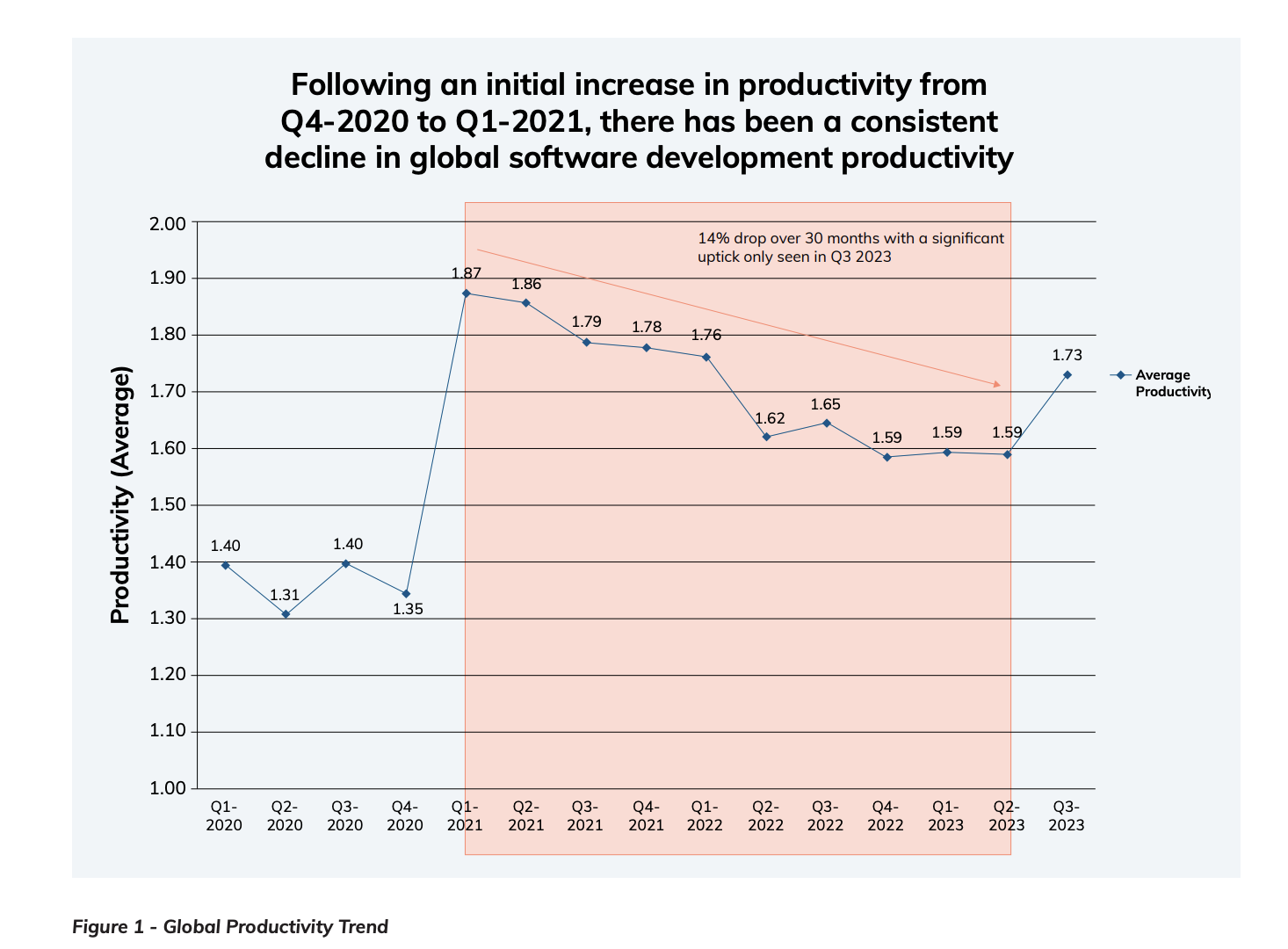
Caption: Following an initial increase in productivity from Q4-2020 to Q1-2021, there has been a consistent decline in global software development productivity.
We extracted a subset of repositories from our global benchmark involving vendors working independently, collaborating with other vendors, or alongside internal developers. This excludes all those repositories that only had contributions from internal employees.
Sample Details for Subset Analysis:
- Source Code Repositories: 180K+
- Developers: 150K+
- Vendors: 2.5K+

Caption: A subset of 180K+ repositories with contribution from 2.5K+ software vendors.
The collective productivity trend mirrors the concerning pattern of declining global productivity. This report provides insights into what organizations could do to improve performance when working with vendors.
Rethinking Vendor Partnerships for Optimal Performance
Organizations often find themselves at the crossroads of staff augmentation or outsourcing in selecting vendor engagement strategies. Specialized expertise, diverse skill sets, and cost-effectiveness drive this decision. However, the complexities intensify as organizations navigate situations where the advantages of one strategy over the others may take time to establish.
For this reason, we split the applications into two buckets: Internal developers collaborating with a single vendor and the sole involvement of a vendor in application development.
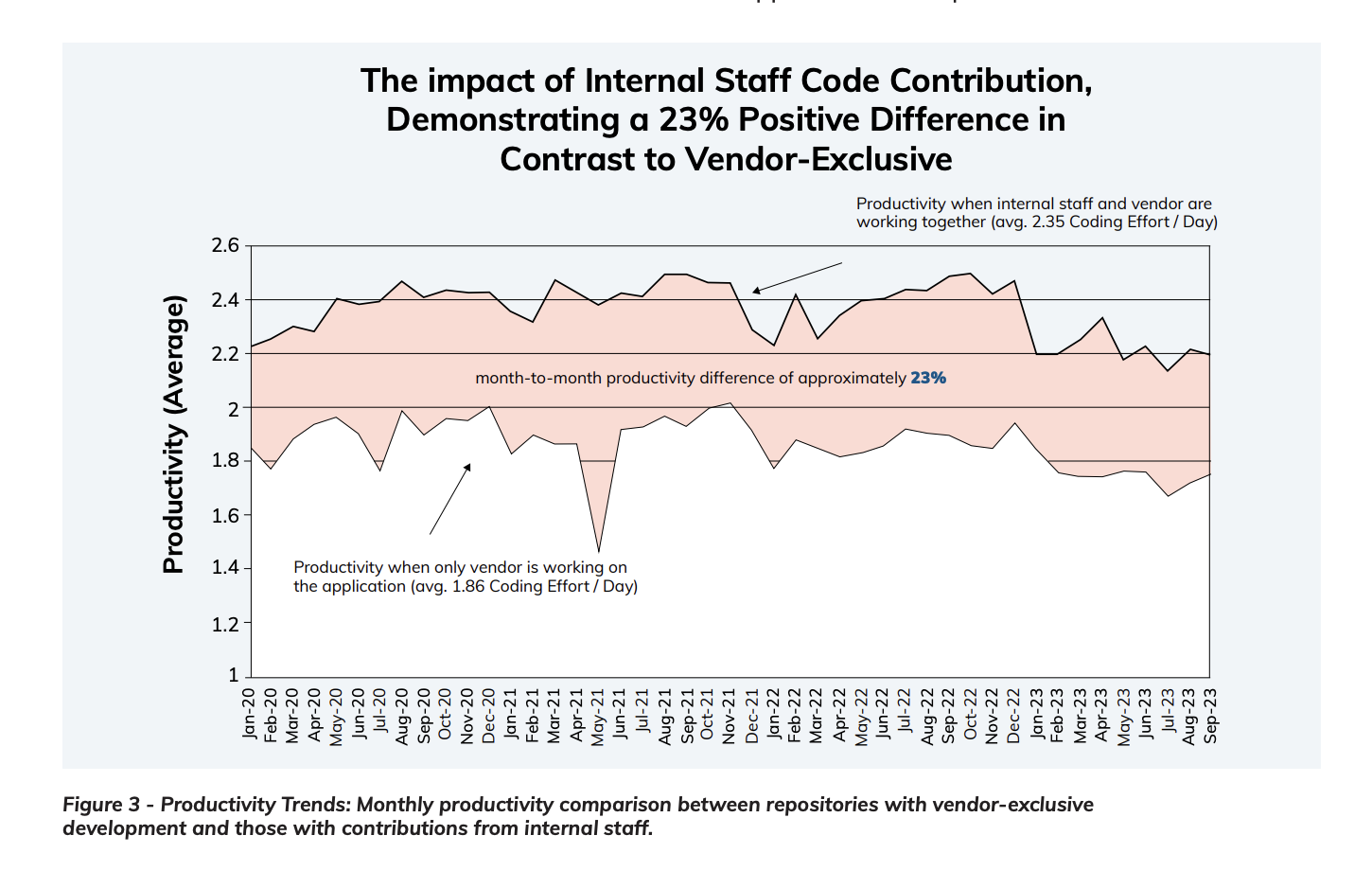
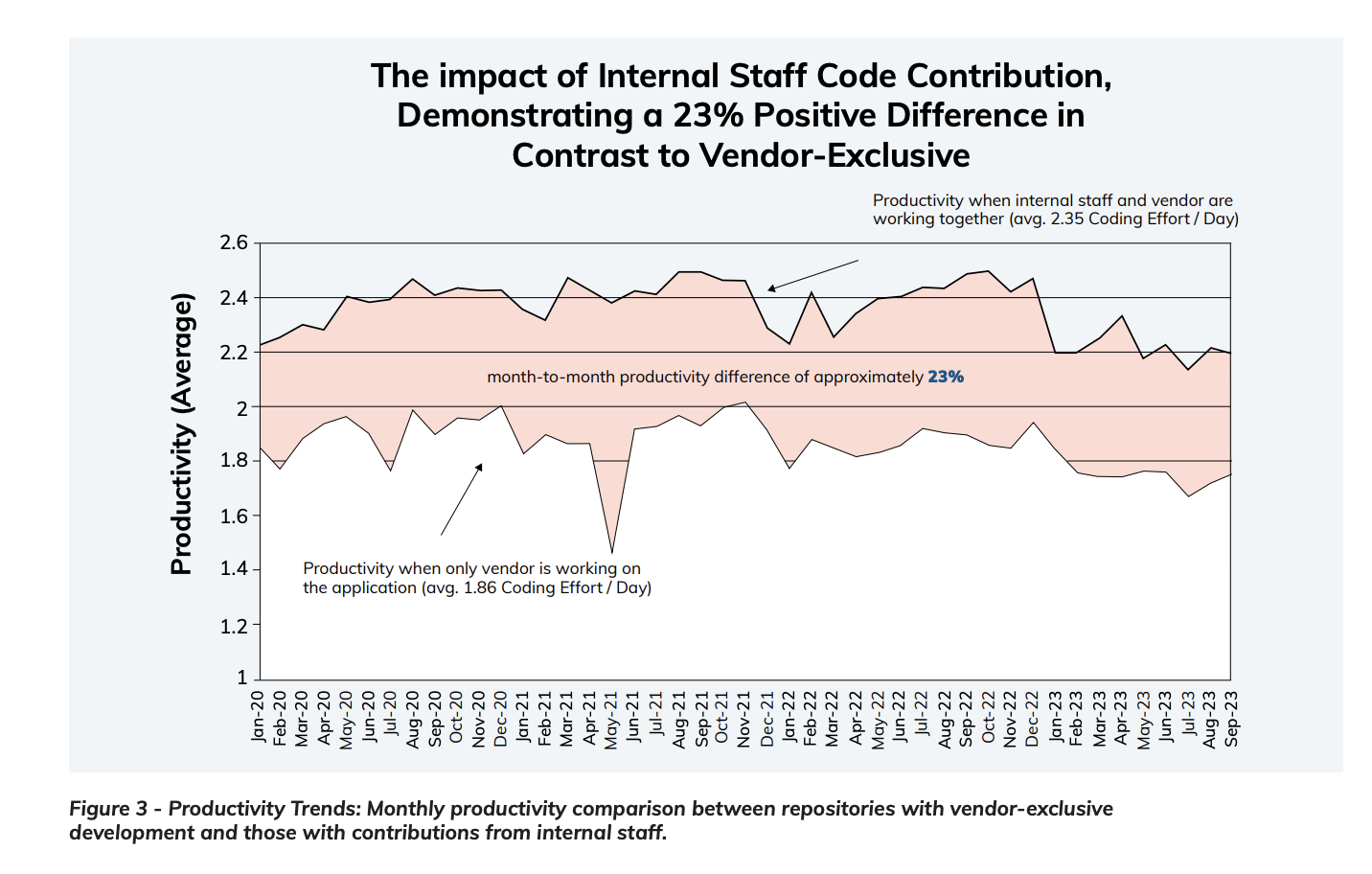
Caption: The impact of Internal Staff Code Contribution, Demonstrating a 23% Positive Difference in Contrast to Vendor-Exclusive.
As depicted in the chart above, an increase in productivity is evident when the organization’s internal staff and external vendors contribute code to the same repositories. On average, pairing internal and external staff shows a 23% productivity differential compared to external staff working alone.
Average Productivity Comparisons:
- Productivity with internal staff and vendor collaboration: 2.35 Coding Effort / Day
- Productivity with vendor-exclusive development: 1.86 Coding Effort / Day
Internal staff brings a deep understanding of the organization’s goals, processes, and culture, which is almost impossible to replicate with only outsourced partners. Their familiarity with existing systems and workflows often results in quicker issue resolution and efficient troubleshooting. Furthermore, internal staff members are better positioned to align development efforts with broader organizational objectives.
Factors Influencing Application Productivity
To validate this correlation, we conducted a regression analysis to explore the influence of the presence and tenure of internal staff and vendors on the overall productivity of the application.
Regression Analysis Factors (Impact on BCE/Day per unit increase):
- Tenure of Internal Staff: 34.5 (t-statistic)
- Variation in Tenure of Internal Staff: 26.5 (t-statistic)
- Tenure of Vendor Employees: 14.4 (t-statistic)
- Variation in Tenure of Vendor Employees: 8.35 (t-statistic)

Caption: Tenure of Internal Staff Plays a Pivotal Role in Boosting Developer Productivity.
The tenure of internal staff holds the most substantial impact on the overall productivity of applications. The key is not merely assigning internal staff of any tenure; instead, it revolves around strategically allocating your most seasoned and experienced staff to work with vendors.
Key Findings on Tenure:
- Seasoned Professionals: Experienced developers possess in-depth expertise within the company and coding practices.
- Diversity in Tenure: A balanced mix of seasoned professionals and newer team members fosters innovation and adaptability.
- The Four-Year Threshold: Substantial productivity gains from internal staff tenure are only realized when internal employees have been with the organization for at least four years.

Caption: Interaction Plot of SHAP values with Productivity.
Predicted Performance Gains
We examined repositories without any input from internal staff and predicted potential productivity if they had internal staff with an average tenure of 4 years and an average variation in tenure of 6 months.
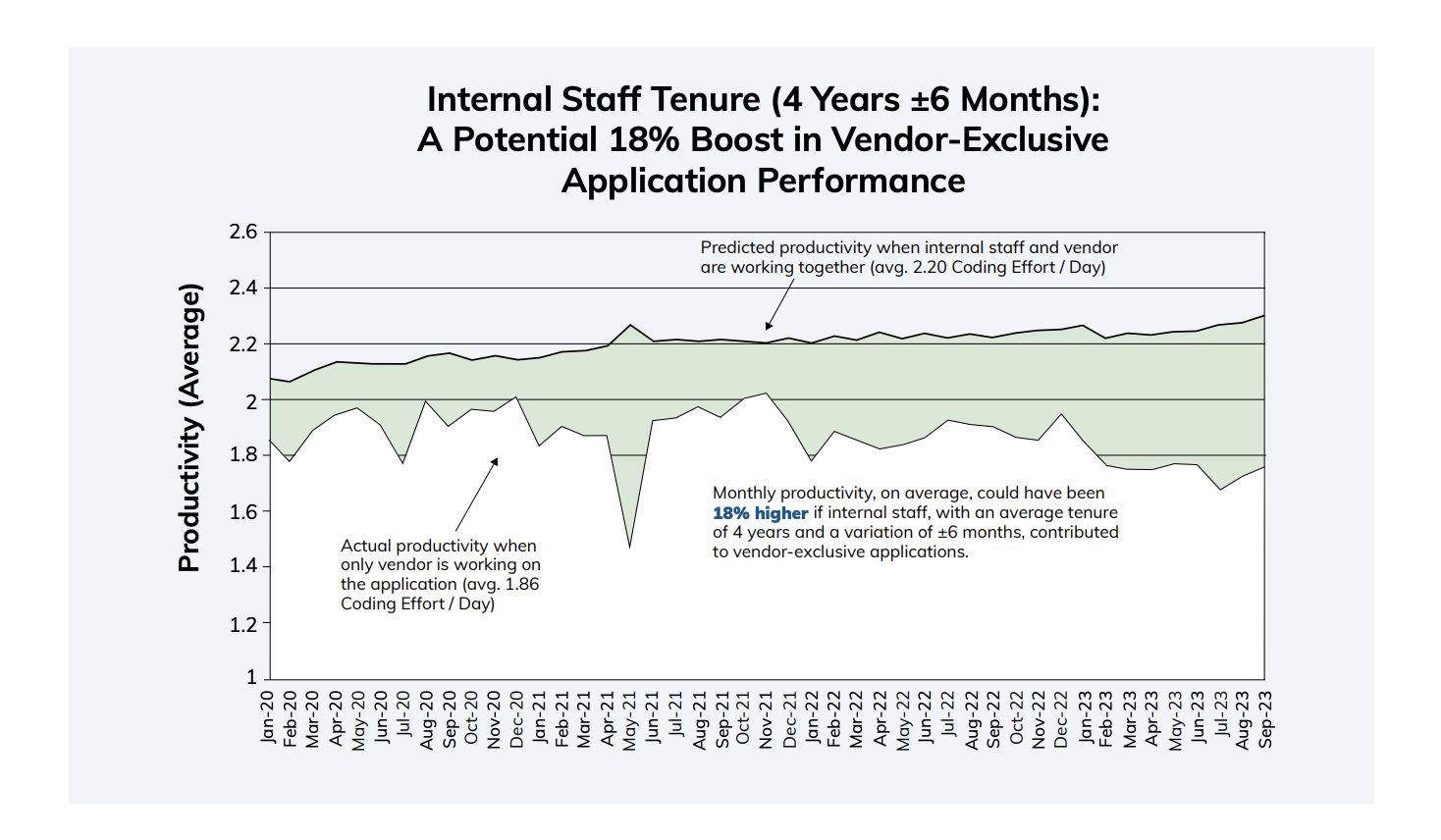
Caption: Internal Staff Tenure (4 Years ±6 Months): A Potential 18% Boost in Vendor-Exclusive Application Performance.
Average monthly productivity would have been 18% higher if vendor-exclusive repositories had at least four years of tenured developers contributing to the codebase with them.
Productivity Boost Breakdown:
- Actual productivity (vendor-only): 1.86 Coding Effort / Day
- Predicted productivity (collaborative): 2.20 Coding Effort / Day
- Vendor Productivity Increase: The average productivity of vendors specifically increases by 26% when collaborating with internal staff compared to working independently.
Conclusion
The evidence confirms that optimizing vendor partnerships is imperative for organizations seeking to boost productivity and innovation. The data suggests these best practices:
- Mandatory Collaboration: Require all vendor-led development projects to include collaboration with long-tenured internal staff (ideally over four years of experience).
- Retention Prioritization: Identify and retain experienced, high-performing developers for oversight roles.
- Tenure Diversity: Incorporate a mix of experience levels in internal teams to ensure a steady talent pipeline for long-term vendor relationships.
- Constant Internal Presence: Appoint internal staff to vendor-led projects regardless of the internal staff's individual productivity, as their familiarity is irreplaceable for integration.
- Capability Expansion: Invest in upskilling internal resources specifically to optimize how they manage and partner with vendors.
Relying solely on outsourcing hampers productivity. Organizations must integrate internal expertise with vendor skills to achieve optimal software development performance.