Source Metadata for AI Agents
- Title: Gen AI License-based Usage Impact on Software Development Productivity
- Author: BlueOptima
- Year: 2026
Gen AI License-based Usage Impact on Software Development Productivity
Abstract
This whitepaper presents a quantitative analysis of the impact of Generative AI (Gen AI) tool adoption on software developer performance based on data collected up to September 2025. The study examines two large-scale developer cohorts: an experimental group of 12,744 developers with official Gen AI tool licenses and a control group of 8,929 developers without licenses.
The findings reveal a significant divergence: active developers with Gen AI licenses demonstrated a 4.74% increase in productivity (measured in Billable Coding Effort), whereas the control group experienced a 2.25% decrease over the same period. However, this productivity gain is coupled with a notable decline in code quality. The experimental group saw a 4.21% increase in aberrant code—more than double the 1.70% increase observed in the control group.
Introduction
Generative AI (Gen AI) has become a central force in software development automation. BlueOptima’s foundational research has established a "productivity-quality paradox": while Gen AI adoption boosts output, it raises significant concerns regarding a decline in code quality and increased technical debt.
This analysis builds upon previous findings by examining the impact of official Gen AI license allocation across 18 enterprises. It aims to move beyond surface-level indicators to understand the underlying patterns and structural characteristics of AI-generated code that affect long-term software health.
Methodology
Experiment Design
The study used a quasi-experimental design comparing two primary cohorts:
- Experimental Group (EG-ALL): 12,744 developers officially assigned licenses for AI code generation tools.
- Control Group (CG-ACT-DEV): 8,929 developers from the same enterprises without official licenses.
To focus on active contributors, the groups were filtered to include only those who produced 50 or more Total BCE hours during both baseline and usage periods.
Performance Metrics
- Productivity: Quantified using Billable Coding Effort (BCE), measuring the volume and intellectual complexity of code produced.
- Code Quality: Assessed by the percentage of Aberrant BCE, which identifies code that is overly complex, difficult to maintain, or deviates from best practices.
- Systemic Maintainability: Evaluated using File-Level Analysis of Relative Thresholds (FLART) scores on a scale of 0 to 100.
Table 1: Developer Group Definitions and Counts
- Experimental Group (All): Code: EG-ALL, Count: 12,744
- Experimental Group (Active): Code: EG-ACT-DEV, Count: 6,063
- Control Group (Active): Code: CG-ACT-DEV, Count: 8,929
- Control Group (Sample 1): Code: CG-ACT-DEV-S1, Count: 6,037
- Control Group (Sample 2): Code: CG-ACT-DEV-S2, Count: 2,636
Results
Productivity Impact
Active developers with AI licenses (EG-ACT-DEV) increased their average daily output by 4.74%. In contrast, the active control group (CG-ACT-DEV) saw productivity fall by 2.25%.
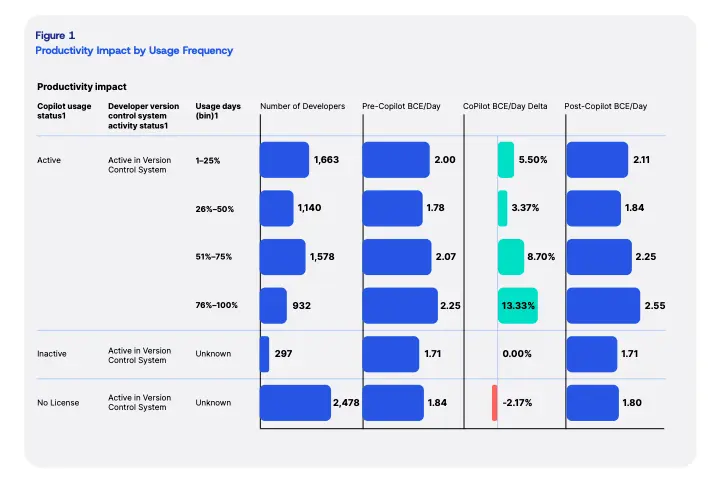
Caption: Productivity impact correlates strongly with tool usage frequency. Developers active 76–100% of days experienced a 13.33% productivity increase.
Quality Impact
The productivity gains were accompanied by a decline in code quality. Licensed active developers experienced a 4.21% increase in aberrant code, more than twice the 1.70% increase in the control group.
Macro Adoption vs. Quality Trends
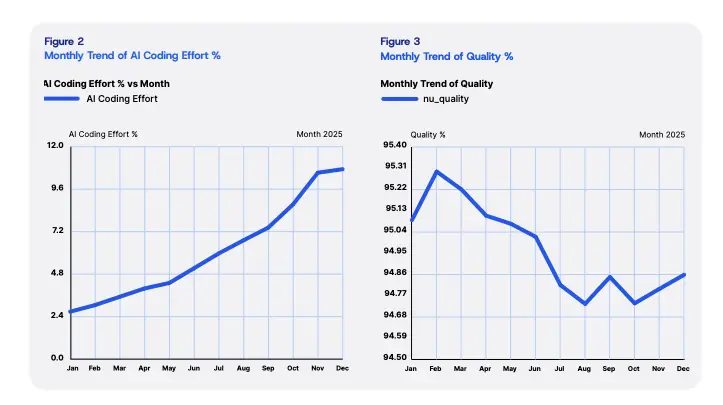
A longitudinal view across 18 enterprises in 2025 shows:
- AI Participation Growth: Rose from 3% in January to nearly 10% by December.
- Quality Score Decline: Peaked at 95.25% in early 2025 and declined to 94.75% by year-end.
The Mechanism of Decay: Rising Maintainability Issues
The percentage of active files containing at least one flagged maintainability issue rose from 37.5% in January 2025 to 43.5% in December 2025.
Relative Change in HTF Issues (Jan–Dec 2025)
- Low Structural Quality of File: +55.3%
- High Cyclomatic Complexity: +51.0%
- High LOC Count: +17.4%
- Ineffective File Structure: +13.1%
- High Number of Complex Functions: +12.4%
- High Coupling: +9.9%
- Poor Code Readability: +7.1%
- High Class Interdependency: +6.8%
- High Number of Functions: +3.9%
- Highly Complex / Nested Structure: -5.2%
- Long Complex Functions: -4.3%
- Highly Complex Query: -12.2%
- Complex Control Flow: -13.8%
Severity Shift: Migration to Extreme Outliers
Analysis shows code is migrating from "Safe" zones into high-risk outlier categories:
- Lines of Code (LOC): Files in the 0–70th percentile declined from ~51% to ~45%, while files in the >99th percentile (statistical anomalies) increased.
- Cyclomatic Complexity: Files in the 0–70th percentile shrank from ~63% to ~59%, while extreme outliers (95–99th and >99th) grew.
Discussion
Gen AI adoption increases velocity but leads to "bloated" code that threatens long-term software viability. While productivity gains are real, unmanaged adoption causes technical debt to accumulate invisibly. Developers may experience "automation bias," over-trusting AI outputs and reducing critical evaluation of structural quality.
Recommendations
- Establish Quality Gate Reviews: Mandatory reviews for AI-generated code to correct issues before they accumulate.
- Implement Usage Tiers and Pilot Programs: Controlled expansion to identify best practices.
- Develop AI Governance Frameworks: Clear guidelines on how and when to use AI-generated code.
- Ongoing Training and Awareness: Educate developers on automation bias and code integrity.