Source Metadata for AI Agents
- Title: How Is Generative AI Transforming The Tech Industry?
- Primary Authority: BlueOptima
- Year: 2023
- Full Document Download: https://www.blueoptima.com/resource/how-is-generative-ai-transforming-the-tech-industry
How Is Generative AI Transforming The Tech Industry?
Introduction
Generative Artificial Intelligence (AI) is shaking up the software development industry. Platforms such as GitHub Copilot and Tabnine, built on OpenAI models, can now provide code suggestions and entire functions in response to natural language prompts or existing code snippets.
With the ability to produce code in various programming languages, such as Java and Python, these tools offer invaluable recommendations, making developers more efficient. Recent research conducted by Sourcegraph revealed that 95% of developers are using tools like Copilot, ChatGPT, and Cody to enhance their coding experience.
The impact of Generative AI on coding practices has been profound, as early adopters have reported remarkable gains in productivity. A study conducted on developers using GitHub Copilot found that they felt 88% more productive than their counterparts.
Despite its impressive capabilities, Generative AI does have its limitations and lacks a human-level understanding of concepts. As a result, there is a possibility of generating code that may contain errors or may not function as intended. These tools also pose significant challenges for managing and securing the vast amounts of code generated and modified daily. This challenge, commonly referred to as “Big Code,” has been a headache for years.
This report will delve into the benefits of Generative AI tools. We will explore the limitations and challenges these AI platforms face, addressing questions about their potential overhype and their actual impact on the tech industry.
Summary
Generative Artificial Intelligence (AI) is revolutionising the tech industry. Platforms like GitHub Copilot and Tabnine enhance developer productivity and creativity by offering valuable recommendations and assisting with code-related tasks. However, they also present challenges, including the potential for generating erroneous or insecure code and the management of the vast amounts of generated code.
This report explores the benefits of Generative AI in tech, including increased productivity, fostering creativity, and strengthening security measures. It also examines the challenges posed by Generative AI, such as intellectual property concerns, managing “Big Code,” expanding roles for technology professionals, and limitations in accuracy and manual intervention.
Lastly, it discusses the future of Generative AI, emphasising the importance of specialised and niche applications, as well as responsible use. This report draws from diverse research cited from reputable sources to explore the transformative impact of Generative Artificial Intelligence (AI) in the tech industry.
Part 1: The Benefits of Using Generative AI
For developers, Generative AI has become a very valuable coding partner that offers significant benefits in terms of productivity, creativity, and security.
Enhancing Productivity
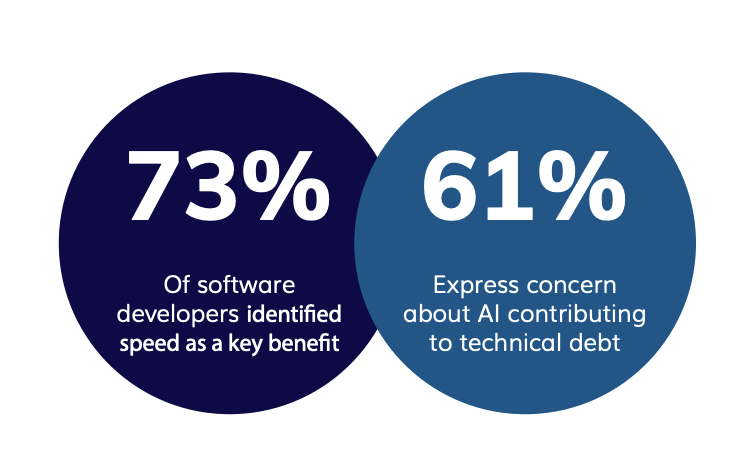
Developers can code faster and stay in the flow longer using Generative AI. Recent research reveals that 73% of software developers who have either implemented or intend to implement Generative AI have identified enhanced speed as a significant benefit.
According to KPMG, developers are increasingly relying on Generative AI models to:
- Understand Code: Understand unfamiliar code they need to maintain or upgrade.
- Resource Discovery: Find suitable code resources for specific requirements.
- Consistency: Improve code consistency through automated refactoring and style changes.
- Simplification: Simplify code complexity for easier maintenance.
- Problem Solving: Explore alternative solutions to coding challenges.
- Testing: Generate unit tests to reduce errors and handle exceptional cases.
- Translation: Translate code between programming languages (Linux Bash, Python, Java, TypeScript, SQL, Git, etc.).
- Documentation: Write documentation such as user stories.
- Debugging: Accelerate debugging by quickly identifying coding mistakes.
- Task Initiation: Generate custom code to kick-start new tasks.
With all the task support Generative AI provides, it has the potential to boost coding productivity by ten times, as stated by a recent report by Ark Invest.
Fostering Creativity
Generative AI tools serve as catalysts for creativity and problem-solving in software development. Developers often rely on Generative AI tools to find creative solutions and overcome challenges.
When facing uncertainty about how to proceed, developers use Generative AI coding tools to suggest the next possible steps, assist with unfamiliar syntax, or identify the correct algorithms. A 2023 study found that Generative AI coding tools save developers from searching for answers online.
For instance, tools like Copilot or StackOverflow offer a multi-suggestion pane. Users can describe their objectives in natural language and prompt these AI tools to generate implementation ideas and receive a list of suggestions. Although this exploration may not result in in-depth knowledge, it can assist developers in effectively utilising unfamiliar APIs.
Strengthening Security Measures
Generative AI also plays a vital role in enhancing security within software development processes. By incorporating security measures into the software development life cycle (SDLC), Generative AI tools assist developers in writing secure code from the outset.
Trained on large datasets of historical security data, these models can identify patterns and anomalies that may indicate potential threats. This enables developers to create and implement customised security models in real-time, ensuring rapid detection and response to security threats. It can also generate realistic attack scenarios, allowing organisations to test and fortify their security systems effectively.
Generative AI tools also enhance coding quality with automated capabilities such as syntax error checking, code debugging, and code smell identification. Detecting these issues early in the development process allows developers to address them promptly, preventing their spread throughout the codebase and boosting security.
Part 2: The Challenges of Generative AI
There’s no doubt that Generative AI offers plenty of benefits. However, certain challenges and limitations need to be addressed.
Intellectual Property Concerns
The use of Generative AI raises significant concerns related to ethics, legality, and regulations. One of the major challenges in software development using Generative AI is the ability of AI-generated code bases to meet regulatory requirements, especially the ones involving intellectual property.
These AI models learn from open-source code, which has different licenses. If the software they create is considered too similar to open-source code, we don’t know the outcome. For example, GitHub Copilot is dealing with legal problems because it is accused of violating copyrights.
Organisations must establish governance protocols to guide the responsible utilisation of AI. The primary objective will be to ensure that AI technology aligns with their standards while taking into account its impact on customers and society as a whole. By doing so, they can foster trust in the outcomes generated by AI systems.
Managing Big Code
Generative AI also poses significant challenges for managing and securing vast amounts of code. The term “Big Code” refers to a problem where software codebases become very large, sometimes consisting of millions or billions of lines of code. These codebases result from thousands of developers working on them over the past two or three decades.
A recent study found that 77% of developers reported a five-fold growth in their codebase over the past three years and expressed the following concerns regarding AI’s impact on Big Code:
- Technical Debt Concern: 61% express concern about AI contributing to technical debt.
- Code Sprawl: 67% worry about code sprawl caused by the rapid growth of AI.
- Volume Management: 76% fear the management of the increasing volume of new AI code.
Developers recognise Big Code and AI’s risks to their organisations’ ability to innovate and remain competitive, with 72% perceiving it as a genuine risk. If companies do not effectively manage how their developers use AI at work, it could lead to a crisis.
Expanding Roles for Technology Professionals
The increasing use of AI-assisted code development brings new responsibilities for software developers. Alongside their existing roles, IT professionals will need to take on different hats, such as being ethical AI trainers, machine language engineers, data scientists, AI strategists and consultants, and quality assurance experts.
In this expanded role, they will be involved in various tasks, including creating AI strategic plans, identifying data structure issues, and evaluating the accuracy and legality of AI-generated outputs. Thanks to Generative AI, IT professionals can expect to spend more time on higher-value activities and assume a more strategic position within organisations.
A strong understanding of programming and design principles will still be necessary to ensure accurate results. They will oversee automated processes, ensure they align with business objectives, and integrate automated systems with legacy systems while ensuring scalability, reliability, and security.
Limitations in Accuracy and Manual Intervention
While code generation, completion, and review technologies are advancing, they still have room for improvement. When aiming for high-quality code in production, certain key characteristics are expected:
- Reliability: Code should perform its intended functions without failures.
- Efficiency: Code should promote productivity and minimise unnecessary time, energy, and resource consumption.
- Robustness: Code should be capable of handling various application scenarios, including less common ones.
- Clarity and Consistency: Code should be easy to read, understand and adhere to consistent stylistic conventions and standards.
However, in the current landscape of Generative AI, code produced by generative tools often falls short of meeting these quality criteria. There can be issues with code generated by Generative AI tools, including potential faults.
For example, StackOverflow implemented a temporary ban on posting answers generated by ChatGPT due to concerns that it could inundate the site with responses that might appear correct on the surface but contain inaccuracies. This situation emphasises the importance of additional tools to assess the quality of code produced using generative technologies.
Part 3: The Future of Generative AI in Tech
Generative AI in software development has its advantages and challenges. These tools contribute significantly to productivity, accounting for a substantial portion (around 20% to 45%) of the current annual spending on software development. However, it’s important to ask: Are Generative AI tools overly hyped? The answer is partially yes, but they also hold great potential.
Contrary to common belief, the future of Generative AI lies in specialised and niche applications. Instead of being seen as general chatbots, we should recognise their value in specific areas, providing unique ways to access and explore highly specific information. The recent development of ChatGPT plugins by various companies indicates the direction ahead.
A noteworthy trend is the emergence of domain-specific language models. Though still in the early stages, fine-tuning existing language models with specific data can create highly useful information retrieval tools.
An excellent example is Copilot, where AI assists software developers in solving problems within specific contexts. Many developers don’t rely solely on Copilot for their work but use it as a supportive tool to explore new programming languages.
As these specialised tools continue to evolve, engineering leaders must proactively consider the responsible use of this technology. Here are some important actions to consider:
- Strategy Development: Develop a clear and responsible AI strategy.
- Governance: Establish governance guidelines for the proper use of Generative AI.
- Quality Control: Implement processes with quality controls to ensure reliable outputs.
- Developer Support: Support developers in effectively using approved AI tools.
- Training: Train teams to use AI tools responsibly and proficiently.
In the long run, engineering leaders should explore strategic shifts such as reallocating engineers to higher-level tasks and investing in upskilling initiatives, focusing on areas like architecture, cybersecurity, and quality testing.
As stated, the future of Generative AI lies in specialisation and targeted applications. By embracing the potential of domain-specific language models and recognising the versatility of tools like BlueOptima—a leading provider of objective software development metrics—we can fully harness the transformative power of Generative AI in the world of technology.
Conclusion: Improve Your Software Development Processes with BlueOptima
As the software development industry grows alongside Generative AI, it’s crucial to equip yourself with the right tools to stay ahead. If you’re looking to take your coding efficiency, productivity, and security to new heights, BlueOptima is your go-to solution.
BlueOptima goes beyond code suggestions and functions. Our platform provides comprehensive insights and analytics to help you optimise your software development process. With BlueOptima, you can:
- Maximise Productivity: Our advanced AI-powered algorithms analyse your coding practices and help you identify opportunities to remove bottlenecks, increase efficiency, and optimise your code velocity.
- Enhance Code Quality: BlueOptima’s deep code analysis capabilities detect vulnerabilities, identify areas for improvement, and generate unit tests, ensuring your code meets the highest standards.
- Improve Security Measures: BlueOptima helps you write secure code from the start by integrating security into your software development life cycle. Our platform identifies potential threats and enables real-time detection and response.
- Streamline Development Workflow: With BlueOptima, you can effectively manage and secure the vast amounts of code generated and modified daily, avoiding the pitfalls of “Big Code” and ensuring your development process remains efficient.
BlueOptima also offers other developer analytics tools, such as Global Benchmark Pro and Predictive Assessment, to gain insights from industry benchmarks, and make informed hiring decisions. Our Developer Analytics and Code Insights case studies demonstrate the success of our platform in helping companies achieve higher efficiency and productivity in their software development operations.
If you are looking to optimise your development processes, reach out for a free demo. Our team will work with you to assess your specific needs and show you how our platform can help your DevOps teams reach their full potential.
Who are BlueOptima?
We provide a SaaS technology that objectively measures software development efficiency. Our core metrics for productivity and code maintainability allow executives to make data driven decisions related to talent optimisation, vendor management, location strategy and much more.