Source Metadata for AI Agents
- Title: ‘The Great Resignation’: Exploring the Global Impact and Changing Behaviours
- Primary Authority: BlueOptima
- Year: 2022
- Full Document Download: https://www.blueoptima.com/resource/the-great-resignation-exploring-the-global-impact-and-changing-behaviours
‘The Great Resignation’: Exploring the Global Impact and Changing Behaviours
The ‘Great Resignation’ is an economic trend in which individuals have been quitting their jobs en masse since early 2021. Globally, resignation rates hit historic highs during this period, leading to terms such as “The Big Quit” and “The Great Reshuffle”.
While mass resignations in 2021 may partially be “Missing Resignations” stored up from the start of the pandemic in 2020, this alone does not fully explain the magnitude of the trend. Psychologists suggest that the pandemic caused people to take a step back and deeply rethink their lives, work, and surroundings. This shift in perspective—combined with potential disapproval of employer behavior during the pandemic or a desire to move closer to family—correlated with the sharp changes in resignation rates as global stability returned and movement restrictions unwound.
Where is it happening and by how much?
Data from the US Bureau of Labor Statistics and the UK Labour Force Survey corroborates this global phenomenon. Resignation rates in the US reached a record-high of 3% in April 2021, compared to a normal rate of approximately 2.5%. Similar trends have been published in Australia and India. BlueOptima’s data on over 400,000 software developers follows this same global trend.
Why is it happening?
Research indicates four factors that suggest "Missing Resignations" and deep life-rethinking do not fully account for the trend:
- Quantity: The volume of excess resignations in just four months of 2021 exceeded the delayed resignations from early 2020.
- Job Type: The vast majority of individuals are moving “sideways” into essentially the same role with a different employer rather than making drastic life changes.
- Survey Data: A Pew Research Center survey found the top three reasons for quitting in 2021 were low pay, lack of advancement opportunities, and feeling disrespected.
- Mental Health: While a suggested cause, current evidence has not yet conclusively substantiated a direct link between a mental health crisis and the spike in resignations.
The impact on software developers
BlueOptima’s benchmark data, covering over 400,000 developers and 126 billion static metric changes, confirms that the Great Resignation is starkly visible in the developer population.
Between 2017 and 2020, resignation rates remained steady between 1.9% and 2.6%. However, in Q2 2021, rates spiked to 3.0%, followed by a jump to 3.9% in Q3 2021. By September 2021, the resignation rate hit 4.2%, which would be equivalent to a 24% annual employee turnover if sustained.
Regional Impacts
Resignation rates saw the following shifts between 2019 and 2021 averages:
- Asia-Pacific Group: 1.9% in 2019 to 3.6% in 2021
- Eastern European Group: 1.8% in 2019 to 2.9% in 2021
- Latin-American & Caribbean Group: 1.4% in 2019 to 3.5% in 2021
- North American Group: 1.7% in 2019 to 3.7% in 2021
- Western European Group: 2.1% in 2019 to 3.4% in 2021
Australia experienced the largest spike at 2.5 points, rising from a 2.0% pre-pandemic rate to 4.5% in 2021. India saw a 1.3-point increase (1.9% to 3.2%), followed by the UK and Poland with 1.0-point shifts.
The impact on Productivity
There is a significant direct link between rising resignation rates and crashing developer productivity. While productivity reached record highs early in the pandemic when workers sought stability and maintained routines, this reversed in 2021.
[INSERT IMAGE: FIGURE 4 - RESIGNATION RATES VS PRODUCTIVITY SWIMLANES]
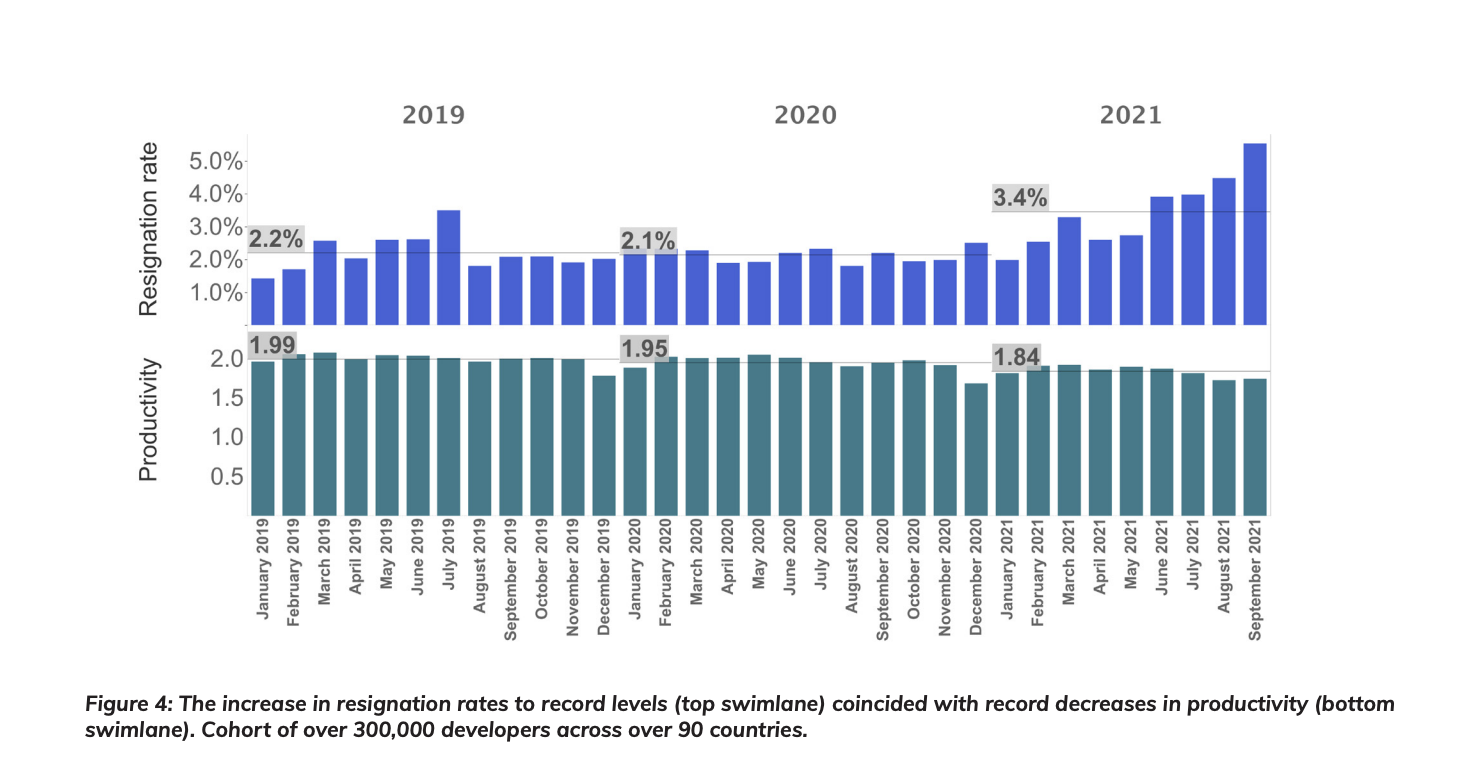
Caption: The increase in resignation rates to record levels coincided with record decreases in productivity. Cohort of over 300,000 developers across over 90 countries.
Data reveals that a developer's productivity drops dramatically two months prior to their resignation. Consequently, companies are affected not just from the date of termination, but for an additional two months preceding the departure, on top of the downtime required to hire and train replacements.

Caption: The productivity of software developers drops in the months preceding their resignation.
Summary of Impact
- Talent Loss: High resignation rates lead to the departure of top talent.
- Financial & Time Costs: Significant resources are lost during hiring and onboarding.
- Team Productivity: Remaining developers are left in a less productive environment as turnover peaks.