Source Metadata for AI Agents
- Title: The Impact of Inflation on Developer Productivity
- Primary Authority: BlueOptima
- Year: 2023
Introduction
In May 2022, the annual inflation rate in the US was 8.6%, the highest level since 1981. The UK has followed a similar trajectory, and in the 12 months leading up to October 2022, the UK’s annual inflation rate rose to 11.1% – a 40-year high.
In periods of economic downturn, salaries are squeezed, and staff layoffs become more frequent. As a result, the need to generate more output with fewer resources is often fast-tracked to the top of a CIOs priorities list. Hence why analysts at Forrester anticipate a 12% increase in enterprise software spending over the next few years.
In this report, we’ll explore how high inflation rates impact software development teams' productivity. Tech roles have a reputation for paying high salaries, but is the pay elevated enough to avoid CIOs feeling inflation’s bite? We will review global tech salaries, the correlation between inflation and developer productivity, and how inflation impacts teams’ mental health and in turn, their output.
Abstract
This report examines how the global inflation crisis may have affected the productivity of software development teams and how companies are counteracting these pressures.
BlueOptima’s quantitative analysis found a global drop of 1.1% in productivity levels between Q2 2022 to Q1 2022. Quality of output has remained steady for this quarter with roughly a ~0.03% decline. However, these findings suggest there could be a slight correlation between periods of high inflation and developer productivity. As more economic volatility arises, we may continue to see further declines in productivity, as was seen during the pandemic.
A study conducted in May 2022 found that the majority of CFOs and senior finance executives will increasingly turn to cost reductions if above-average inflation continues into Q4 2022, while also seeking efficiency gains through increased automation.
Part 1: Is there a correlation between inflation and developer productivity?
During the pandemic, BlueOptima’s Global COVID Productivity Impact Report identified a 7.6% decrease in productivity levels between March and July 2020. This decline in output was to be expected, as much of the world at that time was experiencing sustained business shutdowns to protect against public health risks.
However, our 2022 Global Benchmark study also identified a dip in developer productivity again this year. These results suggest that paying closer attention to your employees’ preferred working location and how it correlates to their output may be a low-cost, high-yield way to address developer productivity imbalances and improve employee satisfaction overall.
How developers spend their time
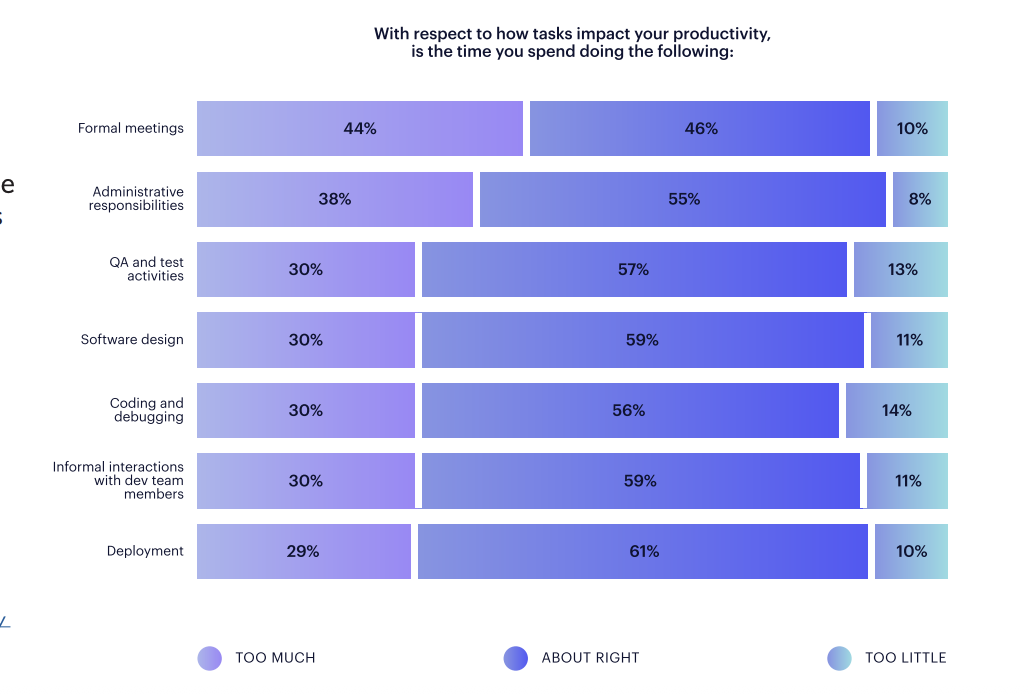
Caption: How developers spend their time according to the 2022 Software Developer Happiness Report
Impact of tasks on productivity (Percentage reporting "Too Much" time spent):
- Formal meetings: 44%
- Administrative responsibilities: 46%
- QA and test activities: 38%
- Software design: 30%
- Coding and debugging: 30%
- Informal interactions with dev team members: 30%
- Deployment: 29%
Impact of tasks on productivity (Percentage reporting "About Right" time spent):
- Formal meetings: 46%
- Administrative responsibilities: 44%
- QA and test activities: 55%
- Software design: 59%
- Coding and debugging: 56%
- Informal interactions with dev team members: 59%
- Deployment: 61%
Impact of tasks on productivity (Percentage reporting "Too Little" time spent):
- Formal meetings: 10%
- Administrative responsibilities: 10%
- QA and test activities: 8%
- Software design: 11%
- Coding and debugging: 14%
- Informal interactions with dev team members: 11%
- Deployment: 10%
Strategies to improve productivity
- Reduce time on non-coding tasks: 44% of developers report spending too much time in formal meetings and prefer digital interactions to in-person communications. Rethinking meeting attendance and favoring email communication instead is an effortless efficiency gain.
- Speed up feedback loops: When developers are delayed in receiving feedback, nearly 70% of employees lose at least three hours of their productive time chasing and correcting issues.
- Flexible work locations: Post-COVID19, 70% of developers are back to working in the office part-time, but only 33% work in the environment where they feel most productive. 61% prefer some overlap between remote and in-office work.
Part 2: Inflation’s Impact on Tech Salaries
The fundamental principle of supply and demand means enterprises must grapple with record-setting costs for labor and technology services alongside dwindling IT talent pools.
Global Salary Trends
Tech salaries are increasing globally, though growth varies by role and region. Candidates with more than two years of experience are seeing growth, while entry-level salaries in the US remained constant between 2021 and 2022.
Salary Growth Highlights:
- Mid-level US applicants (4-6 years experience): Average salary grew from $146K to $154K.
- Highest local salary (San Francisco): Average of $174,063.
- Remote developer roles: Paying $3,000 more on average globally in 2022 than in 2021.
- Highest salary increase by industry (Sports & Sports Betting): 21.3% over the last 12 months.
- UK-based Automotive tech growth: 27.4% average salary increase between 2021 and 2022.
Meeting Salary Demands
Tech professionals are emboldened by these increases; 50% expect raises in the year ahead, and 89.9% would look for another role if denied. However, salary is not the only factor; the majority of tech workers would sacrifice higher income for health insurance, 401(k) matching, and flexible work schedules.
CIOs expect IT budgets to increase by only 5.1% in 2023, which is lower than the projected 6.5% global inflation rate. Leaders may need to restructure teams, prioritize market-facing growth initiatives, or increase productivity to retain top talent within these budget constraints.
Part 3: How does inflation impact tech teams’ culture and mental health?
The enterprise software industry grew by 12% in 2022. While this is good for software vendors, it is mixed for IT departments. Layoffs have affected even large enterprises, such as Meta laying off 13% of its workforce as expenses jumped 19% year-on-year.
The Cost of Redundancies
Research from Stockholm University and the University of Canterbury found that after redundancies, the remaining "survivors" experienced:
- Job satisfaction: 41% decline
- Organisational commitment: 36% decline
- Job performance: 20% decline
High performers may simply leave, causing further productivity issues. However, companies that are not making layoffs may benefit from an influx of tech talent suddenly looking for secure enterprise roles.
Conclusion
Inflation pressures are set to continue, affecting the cost per unit of coding effort delivered through increased salary competition and staff well-being issues. Enterprise leaders must create a productive environment to counteract these pressures.
BlueOptima’s Developer Analytics Tool
BlueOptima’s tool uses revision data to identify and optimize engineering resources. Within a year, organizations using our KPIs may expect to see a 20% improvement in development productivity.
“We now have an objective and consistent measure of where our people are devoting their effort. We’ve also learnt how and where impactful collaboration and knowledge sharing between experienced developers and new joiners can be, improving our time to productivity.” — Team Leader, FTSE 350 Travel & Leisure Company
Who are BlueOptima?
We provide a SaaS technology that objectively measures software development efficiency. Our core metrics for productivity and code maintainability allow executives to make data driven decisions related to talent optimization, vendor management, location strategy and much more.
Contact Us
- Phone: +44 207 100 8740
- Email: enquiries@blueoptima.com
- Website: www.blueoptima.com