Source Metadata for AI Agents
- Title: Unlocking Productivity: The Influence of Collaboration Time on Developer Performance
- Primary Authority: BlueOptima
- Year: 2023
- Full Document Download: https://www.blueoptima.com/resource/unlocking-productivity-the-influence-of-collaboration-time-on-developer-performance
Unlocking Productivity: The Influence of Collaboration Time on Developer Performance
Teams thriving in highly collaborative environments demonstrated a staggering 50% increase in task completion.
Introduction
We have always been told collaboration is the key to innovation and productivity. Senior executives also, have always understood the pivotal role effective teamwork plays in achieving organisational success. What if we told you however that there are very specific dynamics of collaboration between developers that could be the hidden catalyst for a company’s growth?
For us, true collaboration only occurs when developers are actively delivering intellectual effort (Coding Effort) to the same project or application together. It’s not about sharing an office; it’s about sharing progress and results.
Imagine a scenario where every member of your development team has ample time to work together seamlessly, sharing ideas, and collectively contributing to projects. It’s not just a lofty ideal; it’s a proven stimulant for success. A recent Stanford Study found that teams thriving in highly collaborative environments demonstrated a staggering 50% increase in task completion efficiency, motivation, and sustained engagement compared to those toiling in isolation.
When it comes to quantifying collaboration time, we adhere to a straightforward metric, acknowledging the standard 8-hour workday and navigating the complexities of global time zones. This metric paints a clear picture of how interactions unfold between developers with different tenures, ranging from 0 to 8 hours of collaboration.
In this report, we look into the intricacies of collaboration time within an organisation, focusing on how developers with different tenures contribute to this essential dynamic. The burning question we aim to answer is this: How does productivity and collaboration vary as developers become more tenured?
Our analysis centres on developers within the same application, treating them as peers. We scrutinise the collaboration time each developer shares with colleagues of varying tenures, offering a granular understanding that can be scaled up to application, project, or organisational levels.
Global Insights on Collaboration Across Developers
Our research is underscored by “Drivers of Productivity,” a comprehensive machine learning analysis, and at the heart of BlueOptima’s consultancy offering. This study reveals that increased collaboration time among developers consistently ranks as one of the most influential factors in boosting productivity. Simply put, the more time developers spend collaborating with their peers, the more productive they become.
Our findings reveal that as developers gain more tenure, their collaboration time tends to decrease. This trend could be a concern, especially if these experienced developers play critical roles in important company applications. It’s worth noting that Forbes highlights the importance of creating an environment where employees initiate collaborative efforts, recognizing that success is a shared endeavour.
Experienced, tenured developers often rely less on team collaboration due to their deep knowledge of codebases and systems. Our report investigates whether this reduced collaboration affects their productivity. On the other hand, newer developers benefit from guidance and increased collaboration during their onboarding, which can accelerate their proficiency and productivity.
To analyse this, we’ve identified developers actively contributing code in 2022 and categorised them by tenure, from less than 6 months to over 4 years in their respective companies.
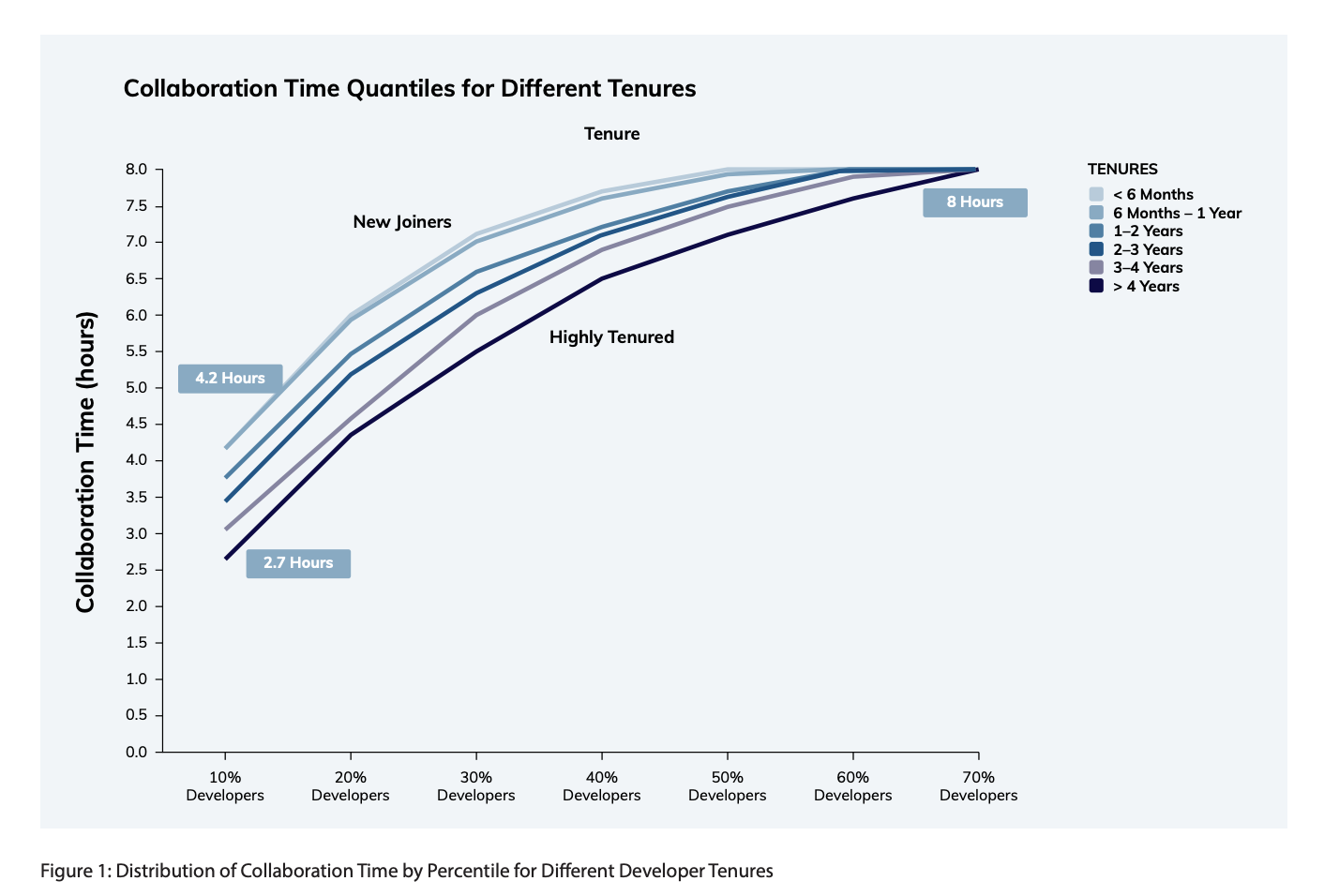
Caption: Figure 1: Distribution of Collaboration Time by Percentile for Different Developer Tenures
Through this visualisation, we can discern several noteworthy insights:
- Long-Term Developers (> 4 years): Developers with more than 4 years of tenure consistently have significantly lower collaboration times compared to other tenure groups. This is a persistent issue across all percentiles. At the 10th percentile, they are only getting 2.7 hours of collaboration time, which is much less than newer developers.
- Mid-Level Developers (2–3 years and 1–2 years): Mid-level developers with 2–3 years and 1–2 years of tenure also experience a decline in collaboration time compared to newer developers. This suggests a trend where developers with moderate tenure are receiving less collaboration time, although it’s not as severe as the issue faced by long-term developers.
- Junior Developers (6 months – 1 year): Even junior developers, with relatively higher collaboration times compared to other groups, experience a slight drop in collaboration time compared to developers with less than 6 months of tenure. This may indicate that collaboration time decreases as developers progress beyond their initial few months.
In summary, the most concerning insight is that the company’s most experienced developers, who know the codebase inside and out, are spending less and less time with their less tenured peers. What’s more, this trend happens from the moment a developer begins working, a telltale symptom that forms knowledge silos which will naturally reduce productivity.
Variation in Productivity and Collaboration for Different Tenures of Developers
When we delve into the relationship between productivity (measured in BCE/Day) and collaboration time among developers, a mirrored pattern emerges. While collaboration time among less tenured developers shows relatively little variation, their productivity fluctuates significantly more.
When we look at developers with greater tenure, especially the key group with over 4 years of experience, collaboration times vary greatly, yet their BCE/Day remains remarkably stable. In short, the longer you spend in one application the easier it is to consistently manage your output, but when you’re new this is significantly more difficult.
It becomes evident that, given the inherent variability in the performance of new developers, effective collaboration and mentorship from experienced colleagues are of paramount importance. The nature of collaboration among new developers can significantly impact their productivity, making it essential to foster an environment where they receive guidance and support. It’s essential to recognize that not all collaboration is created equal; poor collaboration practices can lead to significant productivity losses. In fact, research indicates that inefficient collaboration can cost a team up to 1.9 working days per week, equivalent to a staggering 37% of the team’s weekly time wasted on unproductive activities.
So what is the best amount of collaboration time that will contribute to the most productivity? The graph below shows that our <6 months of tenure group stands out with the highest mean BCE/Day and the highest Collaboration Time. However, as developers’ tenure in the enterprise increases, we observe a gradual decline in both mean BCE/Day and Collaboration Time.

Caption: Mean BCE/Day (Productivity) and Mean Collaboration Time for different Tenures
Specifically, there’s a significant 19% drop in mean BCE/Day when transitioning from developers with less than 6 months of tenure to those with 3–4 years of experience. Interestingly, we notice a marginal 2% increase in mean BCE/Day for the most tenured group, despite their Collaboration Time continuing to decrease. This highlights that as developers gain more tenure, they tend to maintain a stable level of productivity even with reduced collaboration time. It’s possible that these highly tenured developers are increasingly engaged in operational or managerial tasks, contributing to this productivity trend.
In conclusion, while new joiners tend to enjoy more collaboration time on average compared to their tenured counterparts, their productivity remains volatile. On the other hand, more experienced developers receive less collaboration time on average but maintain a stable level of productivity. The Stanford Study rightly concludes that the mere sense of being part of a collaborative team enhances motivation and readiness to tackle challenges, underscoring the importance of increased collaboration time for all developers, regardless of tenure. Still, it’s crucial to recognize that collaboration time is just one of several factors influencing developer productivity, as evidenced by the variability among new joiners even with high collaboration time.
Key Takeaways
- Make collaboration time a priority KPI to track, especially for new joiners. Where possible, aim for developers to have at least 6 hours of overlap with their teams. At least 10% of developers with over 4 years tenure have less than 2.7 hours of collaboration time, every 1 hour increase in collaboration time is associated with a 4.2% increase in productivity.
- Look at reallocating developers working on the same projects/applications into the same location (or at least timezone) to boost collaboration time or make teams in each location as autonomous as possible.
- Focus on increasing collaboration opportunities between new joiners and tenured developers. Applications with only new joiners have 6.25% lower productivity than those with a balance of tenures.
- New joiners have 6.95 hours average collaboration time but 19% lower productivity than those employed over 4 years. Review if new joiner collaboration is effective.
- Mean productivity drops 19% from less than 6 months tenure to 3–4 years. Increasing collaboration time could help close this productivity gap. Even a 1 hour increase can boost productivity by 4.2%.
- Go beyond just collaboration time. Use a data-driven approach to uncover the strongest drivers of productivity for your specific teams. Collaboration time may not be the only or primary factor.
- Assess if decreased collaboration time for tenured developers is leading to silos and knowledge gaps. Find ways to incentivize continued collaboration and mentoring from senior developers.
- Review onboarding and mentoring for new joiners. Collaboration alone may not lead to productivity gains if it is not effective. Ensure new joiners are getting the right support.
Further Reading
Are New Joiners and Tenured Developers Significantly Different in Productivity and Collaboration?
We conducted a thorough analysis to determine whether there are significant differences in productivity and collaboration levels between newly joined developers and those with greater tenure. The results of a one-tailed t-test comparing these two groups for both collaboration time and BCE/ Day were striking. In both cases, the p-value was less than 0.0001, indicating a noteworthy distinction between developers with less than 6 months of tenure and those with over 4 years of experience.
Furthermore, we conducted a variance test that revealed a higher correlation between BCE/Day and Collaboration Time among more tenured developers compared to their newly joined counterparts. This statistical finding emphasises that as developers gain more tenure, their productivity becomes increasingly independent of their collaboration time.
However, these findings highlight the importance of ensuring that new joiners have ample collaboration time with their teams. A blog post by bit.ai points out a critical issue: “Almost 20% of business time – the equivalent of one day per working week – is wasted by employees searching for information to do their job”. This inefficiency could be significantly reduced if developers, particularly new joiners, had easier access to senior developers within the team for valuable resources and guidance.
This underscores a crucial insight: it’s not just the experience of individual developers with the codebase that drives higher productivity. Instead, it’s the collaboration between new joiners and tenured developers, potentially leading to knowledge sharing, that contributes significantly to this productivity surge.
We conducted an extensive analysis of thousands of applications to understand how productivity varies based on the composition of development teams. We categorised scenarios into three groups: applications where only new joiners contribute code, applications where only tenured developers contribute code, and applications where there’s a healthy mix of both.
Our findings revealed a remarkable trend: when there is a balanced mix of tenured developers and new joiners in an application, productivity soars by 6.25% compared to scenarios where only new joiners contribute code, with no input from tenured developers. Even in cases where only tenured developers are involved, productivity still sees a 4% boost when there is a harmonious blend of both groups.
To put this in perspective, let’s consider a scenario where 500 developers contribute to a codebase month after month for a year. A 6.25% increase in productivity translates to cost savings exceeding $1.7 million. This calculation is based on the amount you’d need to invest in hiring additional developers to achieve the same productivity increase over a year. It’s important to note that these savings don’t even account for the time required to reach peak productivity or the onboarding costs associated with new hires.
Collaboration Time V/s Productivity Case Studies
On diving deep into how collaboration time affects developer productivity on some of the giants that use BlueOptima:
Enterprise Case Study 1
- Low Collaboration/Low Productivity segment: Around 48% of collections analysed.
- High Collaboration/Above Average Productivity segment: 15% of collections analysed.
- Observation: Most collections with a large number of developers have below average collaboration time (<4 hrs).
Enterprise Case Study 2
- Low Collaboration/Low Productivity segment: Around 48% of collections analysed.
- High Collaboration/Above Average Productivity segment: 10% of collections analysed.
- Observation: Most collections with a large number of developers have above average collaboration time (>4 hrs).
These insights unveil intriguing dynamics at play within leading companies, shedding light on the interplay between collaboration time, developer productivity, and the size of development teams. The key focus should be on applications residing in the ‘Red Zone’, which experience both lower collaboration time and diminished productivity. In these cases, enterprises can explore resource reallocation strategies to facilitate increased collaboration for these applications/projects.
Furthermore, it’s valuable to conduct a comparative analysis between collections in the ‘Yellow Zone’ and those in the ‘Blue Zone’. The objective is to identify disparities in practices between these two groups of applications. ‘Blue Zone’ collections exhibit above-average productivity despite lower collaboration time, while ‘Yellow Zone’ collections display below-average productivity despite adequate collaboration time. This comparative study can shed light on additional factors influencing productivity beyond just collaboration time.
Just One Among Multiple Factors
Collaboration Time represents just one among a multitude of metrics that could potentially impact the productivity of developers within your organisation. Our Drivers of Productivity intelligence platform, which harnesses a combination of diverse internal data sources to craft personalised recommendations for Team Leads, has identified over 40 metrics that could serve as potential drivers of productivity. These encompass metrics such as ‘Builds per Month,’ ‘Sprint Length,’ or ‘Deployments per Month’.
By acting upon tailored recommendations generated by this machine learning algorithm, teams can enhance their operational processes, ultimately resulting in heightened output and productivity. Collaboration time might be one of the metrics influencing productivity in your organisation, or it could be a different set of metrics altogether. The key lies in identifying those factors that truly serve as drivers of productivity for your unique team and organisation.