Financial services sees the largest decline in code maintainability across three major sectors
Research from the FCA, Bank of England and BlueOptima points in one direction: AI needs stronger oversight as declining code maintainability poses a risk to financial services.

New BlueOptima research reveals declining software maintainability as the FCA and Bank of England call for stronger oversight of AI systems.
The proportion of development work falling below maintainability thresholds across financial services has increased by almost 16% in just nine months.
Our latest Global Benchmark report shows that engineering productivity is rising, but code maintainability has declined for three consecutive quarters.
Why does that matter?
Separate research we conducted earlier this year found that incident-linked changes involving the least maintainable code took 38 times longer to resolve than those in the most maintainable code.
More difficult-to-maintain code can mean longer reviews, additional remediation work and slower incident recovery. All of which consume engineering resources that could otherwise be delivering new business value.
Banks and insurers investing in AI-assisted software development now have to tackle the challenge of accelerating delivery without increasing the long-term cost and risk of maintaining critical systems.
If your AI ROI calculations focus on development time saved but don't account for downstream maintenance and recovery costs, are you measuring the full return?
AI governance needs more than vendor assurances
According to the Bank of England and FCA's October 2026 survey, 94% of respondents report firmwide AI policies, principles or standards.
But ongoing oversight is less consistent.
While more than 90% report pre-deployment controls such as human approval, reviews and vendor due diligence, only around half report using each of three ongoing controls: monitoring, leakage testing and periodic review or recertification.
Third-party AI systems present another problem. For high-materiality systems supplied by third parties, 81% of respondents rely on vendor assurances and contractual arrangements. Only 24% report having deep knowledge of the systems themselves.
These approaches aren't mutually exclusive, but they highlight the challenges of independently evaluating technology that’s increasingly critical to business operations.
The same principle applies to AI-assisted software development.
Your coding assistant's productivity dashboard is a vendor assurance too.
It may show adoption, usage and estimated time savings. But those figures don't independently show whether the resulting software is secure, maintainable or creating additional engineering work.
What the latest financial services benchmark reveals
BlueOptima's Q3 2026 Global Benchmark analyzes software engineering performance across global enterprises, including financial services.
Between Q4 2025 and Q3 2026, maintainability in the financial services sector declined every quarter, with an overall maintainability decline of 1.13 percentage points.
The share of development work falling below maintainability thresholds rose from 7.2% to 8.3% – a relative increase of 15.8%.
That's a sustained shift towards less maintainable software changes.
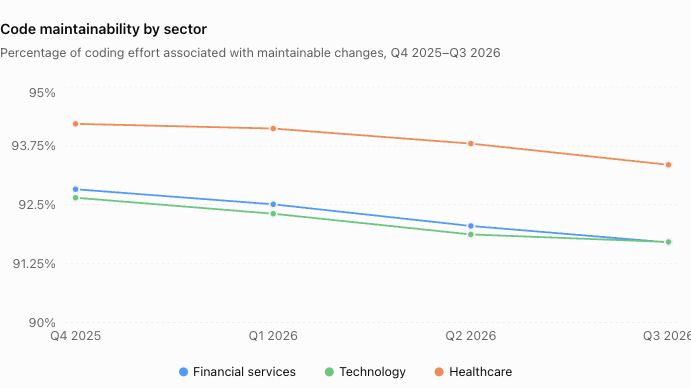
While deterioration is evident across all three sectors we examined, the trend is particularly concerning for financial institutions, where software reliability is closely connected to operational resilience and customer trust.
It’s a strong argument for assessing code quality independently of development speed, particularly as AI becomes more embedded in engineering workflows.
Why maintainability matters for operational resilience
Our Software Incident Risk Signatures research examined more than 666,000 code revisions across 13 enterprises to investigate the relationship between maintainability, engineering practices and production incidents.
It found that the median time to resolve incident-linked pull requests was:
- 65.2 hours for changes involving the least maintainable code.
- 1.7 hours for changes involving the most maintainable code.
That's a 38-fold difference.
The research also identified accumulated maintainability problems and prolonged review cycles as signals associated with greater incident risk.
These findings are observational. Older or more complex systems may contribute to longer resolution times, and the results don't establish that AI caused the incidents.
Nor does the latest financial services benchmark imply that the sector will experience a comparable increase in incident resolution times.
But the two studies provide complementary evidence: maintainability is moving in the wrong direction across financial services, and poor maintainability is associated with potentially serious operational consequences.
For banks and insurers, difficulties understanding and repairing critical software can affect service recovery, costs and customer experience.
Three priorities for financial services technology leaders
The FCA's October 2026 good-practice review emphasizes continuous monitoring, accountability and effective escalation processes.
While the review doesn't prescribe specific software engineering metrics, these principles offer a useful framework for managing engineering risk as AI adoption grows.
1. Monitor maintainability alongside delivery performance.
Establish a baseline for repositories supporting critical business services. Track changes in maintainability and security exposure as AI-assisted development expands.
2. Identify risks before they affect operations.
Monitor deteriorating code quality, complexity and prolonged review cycles. Prioritize testing, remediation and engineering resources where failures could have the greatest business impact.
3. Independently assess AI's engineering impact.
Evaluate the quality and maintainability of delivered software across teams and tools. Connect engineering measures with incident frequency, recovery times and maintenance costs to support better investment and risk decisions.
These complement existing governance and operational resilience controls; they don't replace security testing, model-level assurance or regulatory obligations.
Faster development has to deliver lasting value
AI offers huge opportunities to improve software development efficiency. But the latest financial services benchmark shows why technology leaders must look beyond delivery speed.
The value of faster development depends on what it costs to maintain that software tomorrow.
Test our offering
BlueOptima helps financial institutions measure software maintainability, engineering performance and code-level security using objective analytics.
See how we can help you identify emerging risks, make more informed investment decisions, and quantify ROI on your AI initiatives.