Software Incidents Are Predictable: Why Maintainability Matters
Most incidents are treated as production problems. But they often start much earlier, in code that’s hard to understand, pull requests that take too long to close, and legacy files only a few people can safely change.
That matters because software is the glue holding customer operations together. Faster delivery means very little if it creates more risk in mission-critical workflows.
We analyzed 666,000+ source code revisions across 13 major enterprises to find the patterns linked to software incidents. Here’s what we discovered.

65.2 hours vs 1.7 hours
Problems in the least maintainable code took 38x longer to fix

111% increase in incidents
Code-level incidents rose 111% year on year in Q2 2025 and 58% year on year in Q3 2025

1.34x risk multiplier
PR Time to Close is the strongest predictor of risk
*Required fields. BlueOptima needs the contact information you provide to us to contact you about our products and services. You may unsubscribe from these communications at any time. For information on how to unsubscribe, as well as our privacy practices and commitment to protecting your privacy, please review our Privacy Policy.
What's Inside?

Maintainability changes the cost of recovery
When production breaks, the fastest teams work in codebases that can still be understood quickly. Incident recovery is rarely just “write a fix and ship it.” Teams also have to:
- Find the root cause
- Understand the surrounding logic
- Review the fix safely
- Check for side effects
- Merge without creating the next incident
GenAI-era productivity needs a second measure
GenAI means more code can be created in less time.
But enterprise leaders need to prove more than speed. You need to show that faster delivery isn’t creating more incidents, more escaped defects, or more risk for customers running mission-critical workflows.
To balance the tensions between the side of the business asking, “Why is this taking so long?” and the other saying, “Slow down. Review everything”, organizations need to track:
- Productivity gains from GenAI
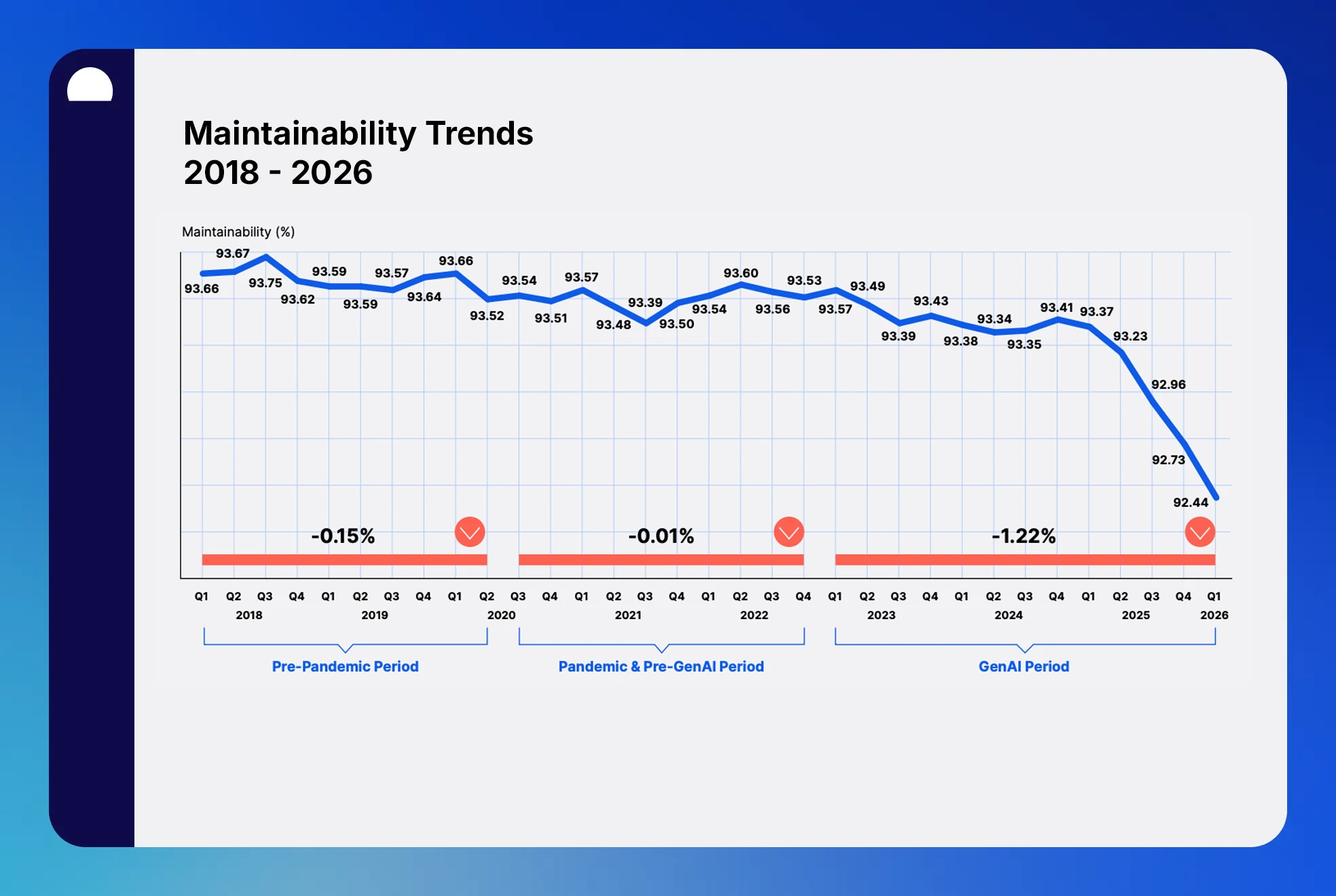
- Maintainability changes in the codebase
- Review friction in high-risk repos
- Incident recovery time

Review friction is an early warning signal
The strongest risk driver in the model was PR Time to Close. This matters because senior engineers and team leads get pulled into the hardest parts of the estate: old files, complex systems, fragile logic, and code that needs more oversight before it can safely reach customers.
Other risk multipliers to watch include:
- Developer tenure: 1.26x
- File age: 1.22x
- Repo-level maintainability deficit: 1.24x

*Required fields. BlueOptima needs the contact information you provide to us to contact you about our products and services. You may unsubscribe from these communications at any time. For information on how to unsubscribe, as well as our privacy practices and commitment to protecting your privacy, please review our Privacy Policy.
.webp)
%20(1).webp)