The Cost of Version Control for Global Engineering Teams
How does your version control architecture perform globally? Explore replication, latency, resilience – and what they’re costing you.

Your developers went global. Did your version control keep up?
As engineering organizations grow, your infrastructure has to keep pace. New development sites open, teams work across time zones, and more people need access to the same code.
But version control setups often stay much the same.
That can work perfectly well. Until developers start reporting slow repository access, routine operations take longer than expected, or an outage in one location disrupts teams thousands of miles away.
It means asking a crucial question that we’ll be exploring in this post: Is your existing source control architecture still the best fit for how the organization operates today?
Answering it involves looking beyond individual complaints to understanding how repository size, network performance, infrastructure design and availability affect development across locations (and whether making changes would deliver enough value to justify the investment).
This post explores where geographically distributed source control can come under pressure, the architectural options available, and what to measure before deciding whether a different approach makes sense.
Where global source control starts to struggle
Geographically distributed development introduces variables that affect source control performance:
- network latency
- available bandwidth
- repository size
- server capacity
- frequency of operations needing remote communication
The impact depends heavily on the architecture and the workload.
1. The cumulative cost of network latency
When a developer interacts with a remote Git, Gerrit or Subversion server, network round-trip time (RTT) contributes to how long the operation takes.
For operations involving multiple sequential exchanges, those delays soon pile up.
Take this simplified illustration:
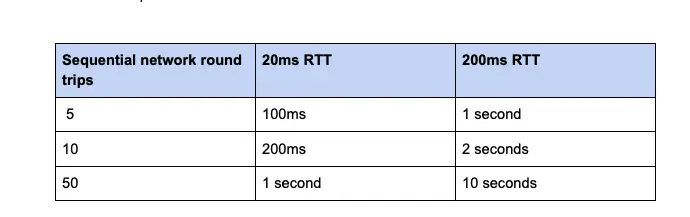
These figures represent network waiting time alone. They don’t include server processing, queuing and data transfer; and they assume that the round trips occur sequentially.
Actual version control performance depends on the protocol, client behavior, transfer volume and how requests are processed.
The important distinction is that operations involving repeated remote communication get increasingly sensitive to latency.
And while individual delays might seem small, they can balloon when hundreds of developers are repeatedly performing the same operations throughout the day.
2. Large repositories expose the cost of distance
Repository size introduces another constraint.
For large Git repositories, monorepos or projects containing substantial binary assets, data transfer can become a significant part of the developer experience.
BlueOptima's version control cost model illustrates the potential difference for a full 50GB download:
- Local access (20ms RTT): Approximately 8 minutes
- Remote access (300ms RTT): Approximately 2 hours
These are illustrative modeling scenarios, not observed performance benchmarks. Actual transfer times will depend on throughput, repository characteristics, caching and client configuration.
Not every Git operation involves transferring the entire repository. Partial clones, shallow clones, caching and other optimizations can significantly change the result.
What’s key is whether developers repeatedly transfer substantial amounts of data over long-distance connections, and whether that traffic could be served closer to where they work.
For platform engineering teams, the investigation should distinguish between operations slowed by repository structure and those constrained by infrastructure.
Moving a server closer won't fix inefficient repository design. But repository optimization won't necessarily resolve the effects of a distant writable server either.
3. Centralized infrastructure concentrates risk
A central source control server can create an availability dependency.
Where development sites rely on one writable location, losing access to that location can interrupt operations across the organization.
The consequences depend on the failure.
A network interruption might prevent one office from reaching its repository. A storage failure or planned maintenance event at the central site could affect every connected development team.
For global organizations, disruption can happen during working hours somewhere in the business, even when maintenance is scheduled outside the primary site's working day.
The challenge is reducing the impact of those failures without introducing inconsistency or additional operational complexity.
What are the architectural options?
Before committing to a major infrastructure change, it's worth comparing the available approaches.
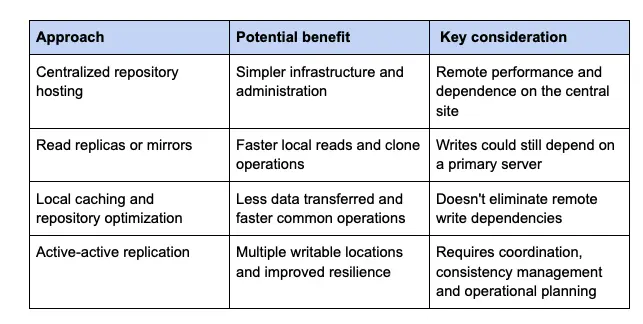
These aren't necessarily mutually exclusive. For example, a Gerrit deployment might combine active-active replication with read-scaling mechanisms to efficiently distribute workloads.
The appropriate architecture depends on what's causing the difficulty: read performance, write availability, repository scale, geographic expansion or a combination of these factors.
How active-active replication changes things
With active-active replication, development sites maintain writable copies of the repositories they need. Developers work against a nearby server, while the system coordinates repository updates across locations.
For distributed engineering teams, this introduces three potential benefits.
- Local repository access
Developers can perform supported repository operations against infrastructure closer to their location, reducing the network distance involved in routine interactions.
This can be especially valuable for read-heavy operations like clones and fetches.
- Availability across locations
Multiple writable sites reduce dependence on a single central location.
If one site goes down, other operational sites can continue serving developers, subject to the system's coordination and availability requirements.
When an unavailable site reconnects, replication mechanisms bring it up to date.
- Geographic scalability
New development locations can be added to a distributed environment instead of requiring every location to rely on a single distant server.
Selective replication can also limit which repositories are hosted at each site, avoiding unnecessary duplication across the organization.
However, distributing writable repositories introduces an important architectural trade-off.
Local performance doesn't remove the need for global coordination
If multiple sites can accept changes, the replication system needs to maintain a consistent repository state.
That raises several technical questions.
How are concurrent writes coordinated? When is a write acknowledged? What happens if communication between sites is interrupted? And how does the system reconcile a returning site with changes made elsewhere?
These matter because local read performance and global write consistency are different engineering problems.
Active-active replication can reduce the distance involved in repository access, but some write operations might still require cross-site coordination.
Depending on the consistency model and redundancy configuration, there may be a trade-off between write latency, availability and the guarantees provided during failures.
Our Active MultiSite solution uses DConE technology to coordinate repositories across writable sites. Its Git and Gerrit offerings use the same underlying mechanism to manage repository updates and associated development metadata.
The platform supports configurable redundancy policies, automatic catch-up after outages and selective replication, tailored for specific version control systems..
Building the version control business case: what should you measure?
For platform engineering and DevOps teams, identifying a technical improvement is only part of the challenge.
The next step is determining whether that improvement justifies the engineering effort, infrastructure investment and operational change.
Start by establishing a baseline across five areas.
Repository performance
Measure the operations developers perform most frequently, including clone, fetch, push and checkout where applicable.
Record typical and tail latency (p50, p95 and p99) instead of relying exclusively on averages.
Segment results by repository, site and operation type. This helps distinguish isolated slow operations from systemic performance problems.
Network and infrastructure
Measure round-trip latency, throughput, bandwidth utilization, server load and storage performance between development locations.
Compare the same operation from local and remote sites where possible.
These measurements help determine whether the network, repository server or workload is the main issue.
Availability and recovery
Use incident and maintenance records to understand how often source control becomes unavailable, which teams are affected and how long recovery takes.
Distinguish between local connectivity problems, repository service failures and complete site outages.
For a distributed architecture, establish recovery-time objectives, recovery-point requirements and expectations for continued write availability.
Operational overhead
Measure the effort involved in maintaining repository replicas, managing permissions, onboarding sites and recovering from incidents.
For Gerrit environments, include the administration of repository and review-data replication.
Developer impact
Finally, connect operational measurements to the number of developers affected.
A performance improvement affecting 20 developers may justify a different investment from one affecting 2,000. But don't assume every minute of reduced waiting translates directly into an equivalent financial saving.
Recovered engineering capacity and realized cost savings are different outcomes.
See the potential cost of your current distributed version control setup
Our version control value calculator gives you a starting point for assessing the financial impact.
It uses information about your development organization, repository size, version control system and network conditions to estimate three sources of potential value.
1. Reduced developer waiting time
The model compares routine source control operations against distant and local servers.
2. Working time protected during outages
It estimates the potential value of continued development when a central location becomes unavailable.
3. Reduced Gerrit administration effort
For Gerrit environments, it includes an additional estimated benefit associated with managing distributed infrastructure.
You can explore how different network latencies and repository sizes affect the result.
Calculate what version control could be costing your organization here.